

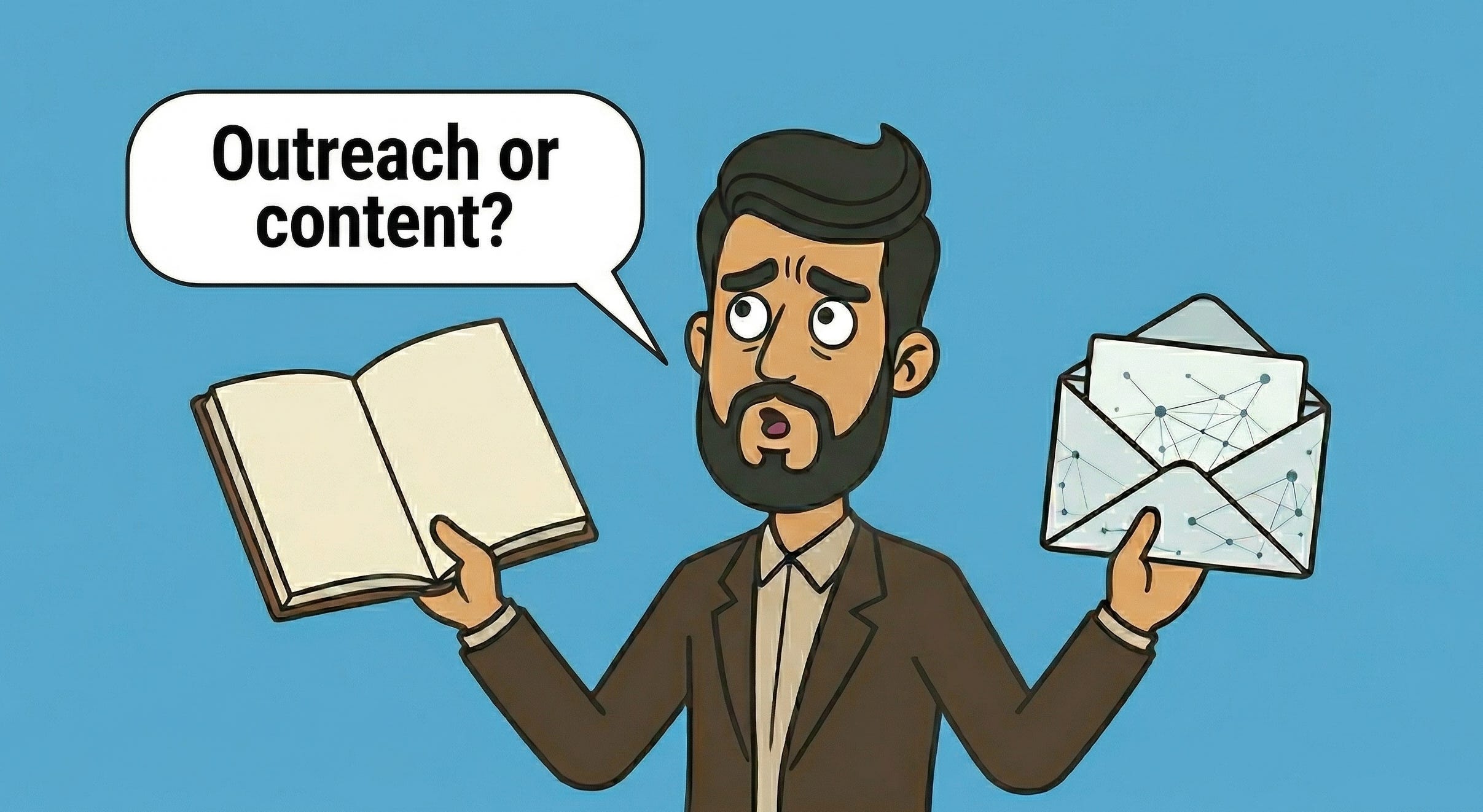
Alex Hormozi can afford to do this. You can’t.
I’m talking about the mistake founders make of only doing content. The idea that LinkedIn posts alone will fill your pipeline without a direct sales layer.
Hormozi sold 2.9 million books in 24 hours because he already had a following. Super-influencers like Hormozi represent the 1% who can survive on tiny conversion fractions because their reach is so massive. Hormozi plays a one-to-many game where a 0.01% conversion rate still yields enough business.
For a micro SaaS or a service business founder, it’s a different story. You need to struggle over every lead, and traction with content is truly a long game.
The good news? You don’t need to be Hormozi to succeed. You just need to mix your content efforts with proactive outreach.
“Wait… are you, of all people, telling me content is not enough?”
It sounds counter-intuitive for a content professional to say ‘content isn’t enough,’ but I’m sharing the exact methods currently fueling results for my clients and my own business.
Recently, I met a founder who inquired about my service, and after a short talk I understood we weren’t aligned. He expected some sort of magic from my content abilities. As if he’ll start posting on LinkedIn and by post #2 people would DM him and ask for a demo of his product.
I don’t think that ever worked like that, for anyone. (Maybe only for p0rn stars…😁)
Expecting immediate leads from two posts is a delusion. Real traction typically takes 2 to 4 months of consistency, and usually comes coupled with direct outreach efforts. Attempting a content-only playbook without a sales layer will most likely just cause you to burnout and stop posting altogether.
You’re betting all your chips on an algorithm in a post-click era where nearly 60% of searches end without a click, in a feed already flooded with AI slop.
If the leads don’t come, the founder usually panics and disappears for six weeks to find sales. By the time they come back, the audience trust has reset to zero, and they’re back at level one of the game.
So what’s the solution? How can you balance outreaching AND content creation?
In the past I’ve written about adapting to busy times using my Base and Bursts method.
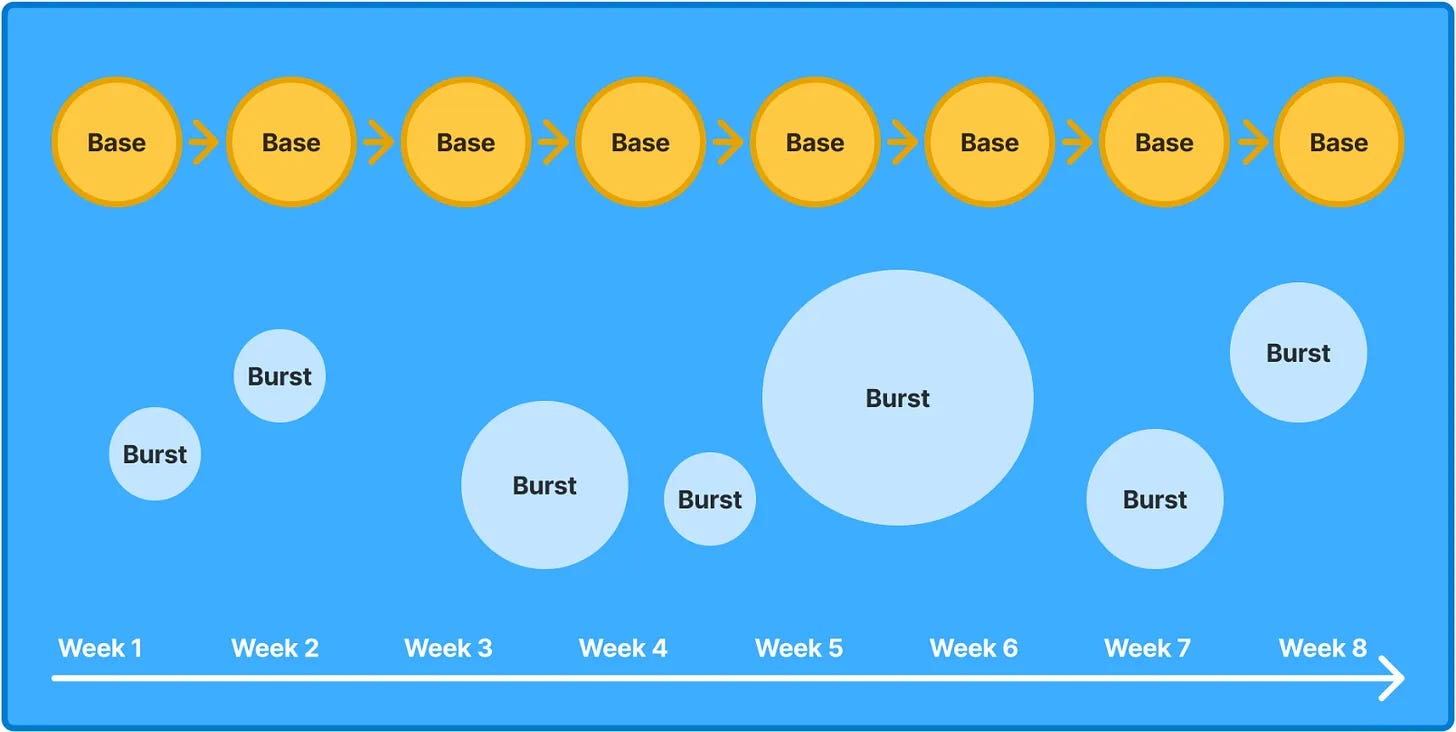
This method allows you to dynamically align your effort with your current monthly runway.
You can use the same method to decide how to balance your content and outreach efforts:
Need Sales Now? Pivot your Pareto to 80% Outreach to fill the gap, but keep your Base content (a 1–3 hour effort a week), so you still keep the awareness of your audience and look credible when prospects check your profile.
Enough Clients? Dial back the manual outreach and invest that energy into what I call Bursts, in addition to your Base. These are calculated marketing experiments, like podcast circuits or high-value webinars, that scale your authority while your Base protects your consistency.
Most small businesses ignore the intersection of content and outreach. I’m telling you it’s the only sustainable path.
What happens when a founder, desperate for leads, tries to post content that’s supposed to produce leads?
A founder posting out of desperation smells like a commission breath, and prospects can sense it from a mile away.
When this happens, the resulting content is often salesy, and gets no engagement. Sadly, I see these orphaned posts all the time on LinkedIn.
The influencers we’ve talked about provide a great blueprint to avoid this salesy trap, but only if you know which parts to copy and which to ignore.
Influencers like Hormozi or Jack Conti aren’t usually salesy because they don’t have to be. They operate at a scale where the math does the heavy lifting for them:
They produce a high-value episode that reaches 100,000 people.
During that episode, they promote a free, non-salesy template. 10,000 downloads.
2% click the “Free Consultation” CTA within that template. 200 high-intent leads.
They’ve just generated 200 high-intent leads from a single piece of content!
If you try to build that exact machine today, you will fail because you lack the 100K views. You cannot afford to wait for a 0.01% conversion rate to put food on the table.
However, like them, you should also continue to put out non-salesy content. Instead of expecting the leads to come from that contet, you should also make a direct sales outreach effort.
In other words, you shouldn’t waste weeks building multi-step automated sequences. You don’t have the volume to justify this.
Use your content to build Trust as your Base (1–3 hours a week), and simultaneously use Proactive Outreach as your primary engine to actually fill the pipeline.
What does this system look like in practice?
If you haven’t read about my post regarding building your marketing system, I highly recommend you do.
Here is what this hybrid approach looks like:
Lock in your Base: You put out one high-authority LinkedIn post a week. This is your non-negotiable minimum. The best testament to your expertise that stays live 24/7 so you look credible when prospects inevitably check your profile.
The Outreach Engine: You spend the remaining 80% of your marketing time on direct conversations and sales calls. Instead of waiting for the algorithm to bless you with a lead, you go to them.
Important! Make sure your outreach doesn’t suck. You do this by initiating a win-win exchange. Try to be in the know” for your prospects. Identifying their specific challenges and offering a direct perspective that AI-generated noise can’t replicate.
This works because content and sales are a virtuous cycle. Your LinkedIn post builds the authority so that when you land in a DM, you aren’t a random solicitor, you are a recognized expert they’ve already seen in their feed.
I won’t teach you the full mechanics of outreaching theory today, that’s a topic for another issue. but I can tell you from my work with founders, it is a great way to get more revenue and piece of mind when the business reality demands it.
When do you stop outreaching?
The short answer: When you are out of the jam.
You stop the heavy, manual outreach once you have enough clients to sustain your business with peace of mind. Until that runway is secure, outreach is your primary growth lever.
Once you gain those needed clients, you need to sit down and realign your efforts toward more long-term marketing activities. This is the moment you shift your focus from hunting leads to building a brand that attracts them.
If you’re stuck in the jam and need want some help regarding bridging the gap between outreach and authority, reach out and I’ll try to help.