

My job is helping founders succeed on LinkedIn. A few months ago, I asked a client of mine who is his biggest inspiration.
He mentioned Gala Aga, the CEO who runs Aligned.
Aligned is a sales software company of about 60 people that just raised a $60M Series B.
Gal indeed has built a strong personal brand on LinkedIn. When he talked about the round, he mentioned a line from an investor’s memo: Aligned “has the brand of a company 5x its size.”
According to Gal, that brand was built almost entirely on LinkedIn. That’s a big claim for a CEO who posted only 13 times in the two months I analyzed. So I wanted to see what he’s actually doing.
Gal’s overall strategy
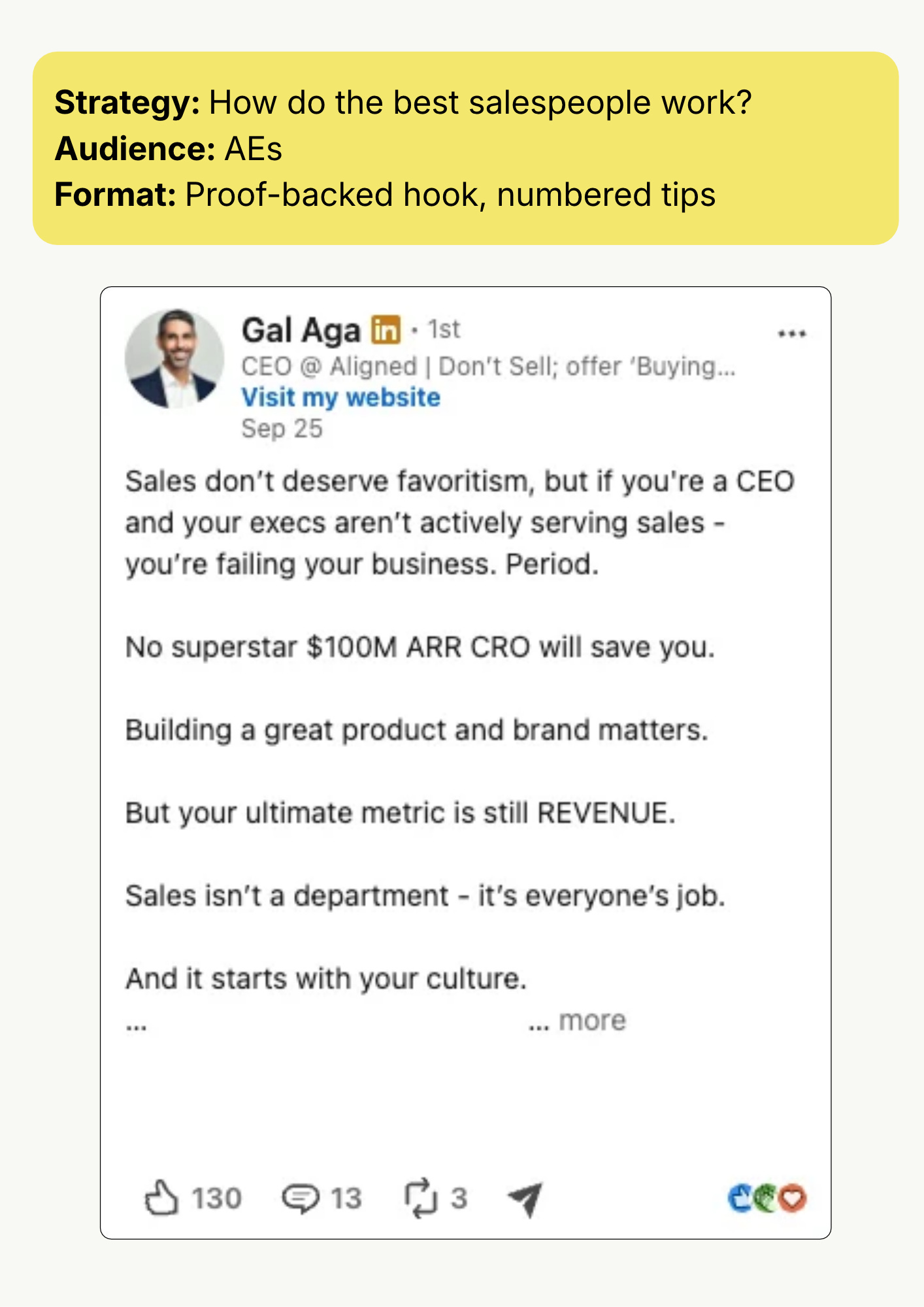
Gal doesn’t post a lot. 13 posts in two months is about one and a half a week, which is less than most founders I work with. But every post is doing a job.
Almost everything he writes comes back to one question: how do the best salespeople work?
He tells stories about his top AE, who hit 200% of quota two years in a row. He shares what a friend who makes $1M a year as an AE does differently. And he gives long lists of tips from his own 21 years in sales.
The interesting part is who he’s writing for. Aligned is bought by sales leaders, but it’s used every day by AEs. Gal writes for the AEs. I think this is smart, because helping AEs sell better is exactly what Aligned does. So his content and his product are basically the same promise.
On top of that, he has a fixed format. Most posts look the same, open the same way and close the same way. And once in a while he breaks the routine with a campaign, a series of posts that follow one project from start to finish.
So the strategy is pretty simple: one audience, one question, one format, and the occasional campaign. Here’s how each part works.
1. Write for the people who use your product, not the people who buy it

Most B2B founders write for the buyer. It makes sense on paper, because the buyer is the one who signs the check. So they write about ROI, strategy and “the future of the industry,” aimed at VPs and C-levels.
Gal does the opposite. His readers are AEs, the people who sit in Aligned every day. His posts help them close more deals: how to get budget through your champion, what to do between sales calls, what mistakes kill a multithreaded deal.
I think this works for a few reasons. There are a lot more AEs than VPs of Sales, so the audience is bigger. AEs actually have the problems he’s writing about, so the posts feel useful instead of abstract.
There’s also no gap between the content and the product. Aligned helps AEs sell better. Gal’s posts help AEs sell better.
If you want to steal this, ask yourself who uses your product day to day, and what problem they’d thank you for solving. Then write about that, even if those people will never be the ones paying.
2. Pack your posts with tips
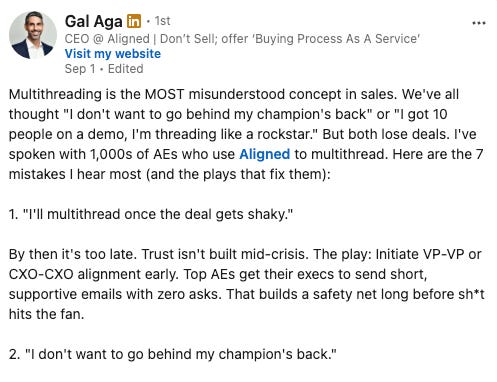
Gal’s default post is simple. He takes one question and answers it with a long list of tips.
5 steps for getting budget through your champion.
7 multithreading mistakes.
10 moves to make between sales calls.
10 things he wishes someone had told him on day one.
A lot of people would call this basic. Listicles have a bad name on LinkedIn, mostly because so many of them are generic. But Gal’s tips aren’t generic. They come from 21 years in sales, hundreds of AEs he’s managed, and now running a company that sells to sales teams. These read like advanced, insider tactics, the kind of thing a great sales manager tells you in a 1:1.
If you want to steal this, don’t start with the list. Start with what you know that most people in your space don’t. Then break it into steps. Try to uncover real tips you see during your workweek.
3. Run a “project post”

A project post is what I call a series of posts that follow one project or campaign from start to finish. Few founders do it, mostly because it takes planning. Gal did it this month, and it was probably his biggest win.
Aligned ran an event with LinkedIn called The Order of the Closers, a “secret society” for the best AEs and CSMs. Gal backed it with four posts:
Two posts to recruit members. The first announced the event and explained how to get in. The second reads like his regular tip posts. It tells the story of his top AE and three things he did differently, and only asks for nominations at the end.
Gal published another short post during Dreamforce, after US news picked up the story.
and one last post afterwards that tells the whole story and the results.
The results: 45 seconds on CBS News and 60+ posts from other people tagging Aligned.
I like a few things here. The campaign fits his audience perfectly, because it’s built for the same AEs he writes for every week.
And by posting before, during and after, he turns one event into a story people can follow. Each post gives readers a reason to care about the next one.
If you want to steal this, pick one thing you’re already doing (a launch, an event, a big customer project) and plan the posts around it before it happens. Announce it, share what’s going on while it happens, and then tell people how it went.
4. Use the same structure every time

Almost every post Gal writes is built the same way:
An opening line with proof and a big claim
A numbered list
A divider line
A few short closing lines
Sometimes a P.S. about the product
The opening usually puts a credible person or number up front (his top AE, a friend who makes $1M a year) and makes a claim big enough that you want to see the list.
The divider separates the value from the wrap-up, so the post doesn’t drag. And the P.S. is where he pushes the product.
Some people worry that a formula makes you predictable. I think for a busy CEO it’s the opposite. Gal runs a company of about 60 people that’s still scaling. He doesn’t have time to reinvent every post. With a structure that works, the only question left is what to say, not how to say it.
Readers benefit too. Once they know the format, they know what they’re getting.
If you want to steal this, look at your best three posts and find what they have in common. Turn that into your template. Then stick with it long enough to see if it works, instead of changing it every week.
Summing up
Here’s what Gal does:
He writes for the people who use his product, not the people who buy it.
He packs his posts with tips that come from real experience.
He runs project posts that turn one campaign into a story.
He uses the same structure every time, so each post takes less work.
Who should I cover next? Reply and let me know.