

Anthony Pierri runs a two-person positioning agency that makes about $1.7M a year. He posts on LinkedIn almost every day, and he says 95% of his clients come from there. No paid ads, no outbound, no other channel.
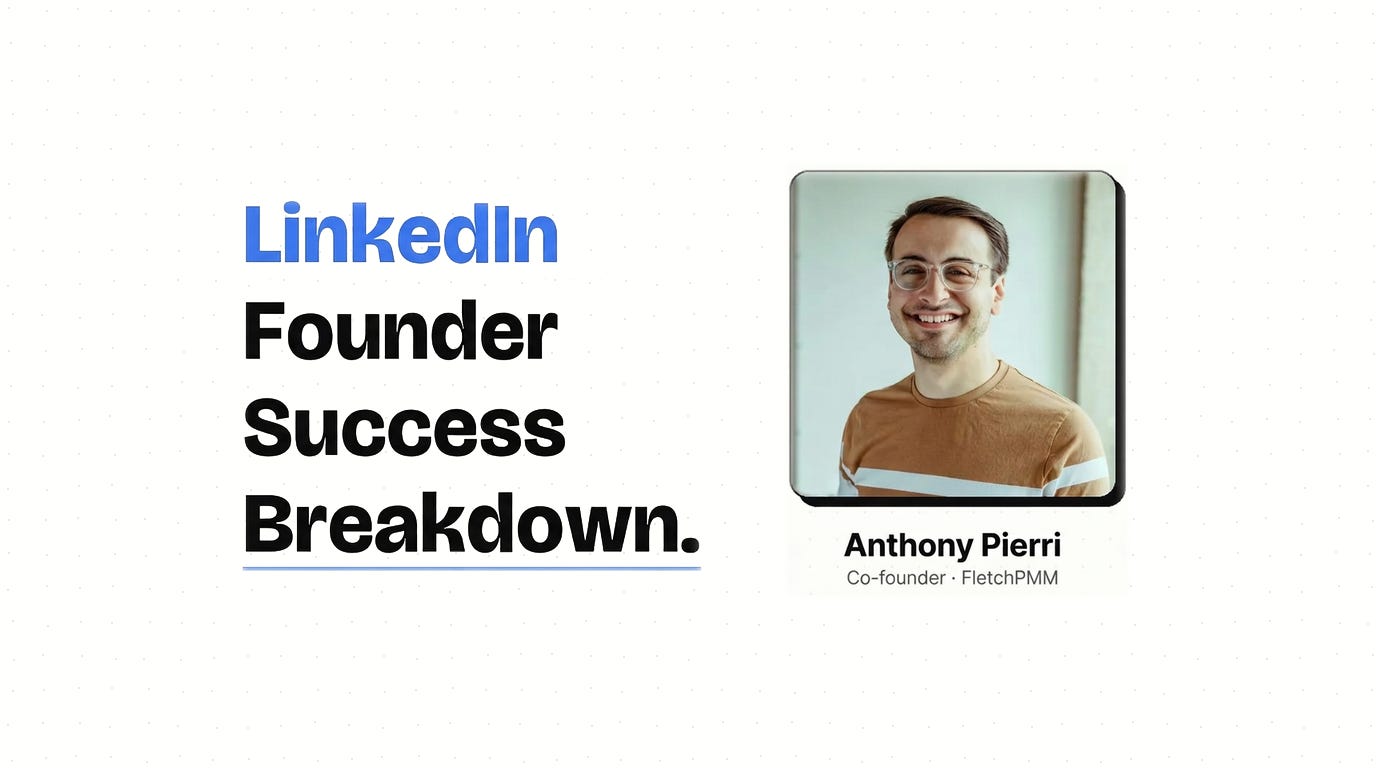
So I pulled two months of his posts (60 of them) to figure out what he’s actually doing, and what a solo founder could steal from it.
1. Stays on track on one subject matter - positioning
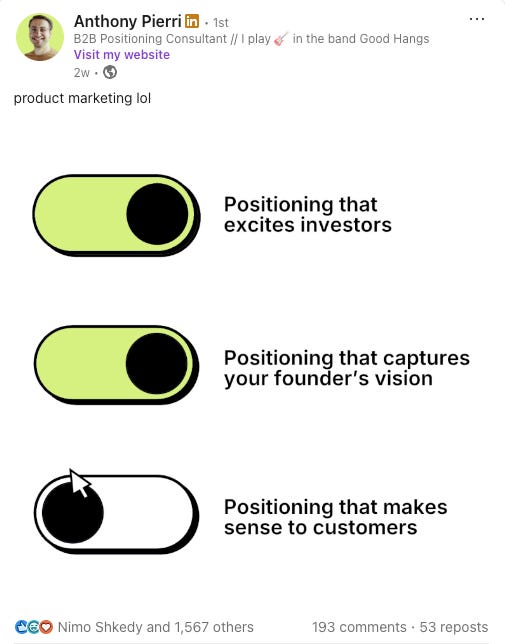
The first thing you notice is how narrow he stays. Almost everything he posts is about positioning, which is exactly what he sells.
He’ll write about homepages, about defining your customer, about choosing a category, but these aren’t separate topics. They’re all parts of the same problem: if you don’t know who you’re for or what you are, your homepage can’t work. The path from any post to his offer is short.
I think he stays this narrow for two reasons.
First, it builds trust with the right people. Founders and product marketers see him talk about positioning day after day, and they start to expect it from him.
Second, it makes the algorithm’s job easy. LinkedIn knows exactly who to show his posts to, because he rarely gives it mixed signals.
Would I always recommend following this rule of focusing on one topic? YES!
2. Pierri invests heavily in visuals
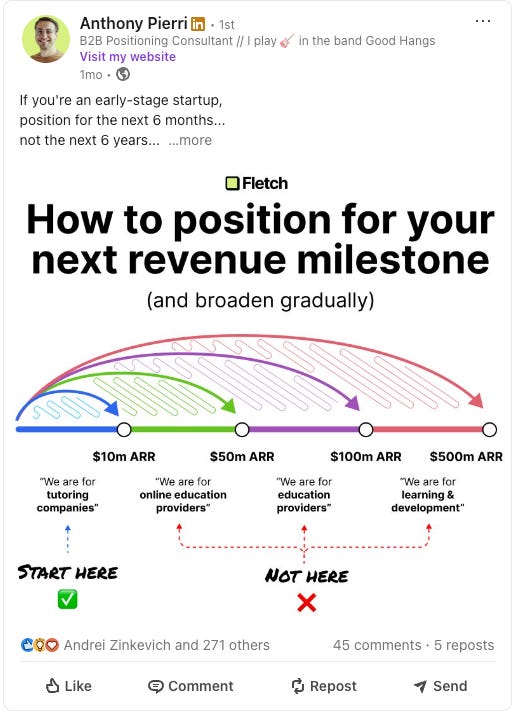
The second thing you notice about Pierri’s posts is the visuals. Every image he posts is clearly thought through. He doesn’t just list his points on a slide. He draws them so you can get the idea while scrolling, without having to read anything.
Look at this one, on how your positioning should change as you hit different revenue milestones. Instead of a list of stages, it’s a colorful timeline. You can see where you are on it and what comes next in about two seconds.
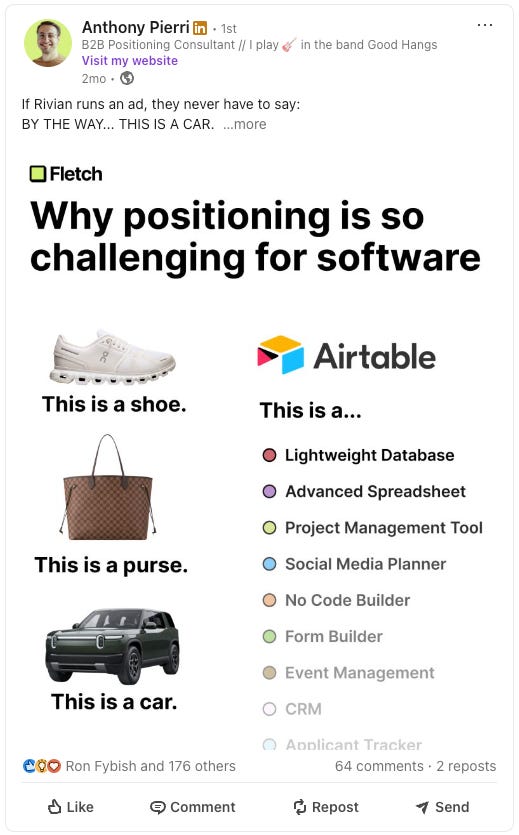
Or this one, on why software is harder to position than consumer products. On one side there’s a shoe. On the other, Airtable. You know what a shoe is the moment you see it... you don’t really know what Airtable is.
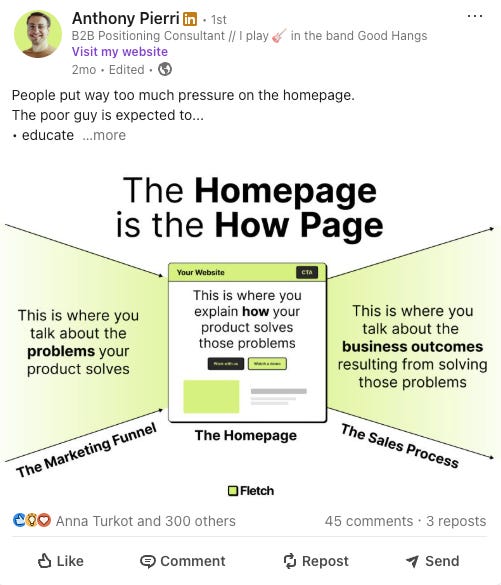
Here he’s showing the job of the homepage, compared to the job of marketing and the job of sales. Notice the visual isn’t just the parts of his argument laid side by side. It’s a map. You go from marketing, to the homepage, to sales, and you can see where the homepage sits in between. You’ll see this same use of a visual map come back in a lot of his posts.
Would I always recommend differentiating your content with visuals? Not always, because it requires much effort and skill, but I have seen it work for many LinkedIn influencers.
3. Pierri goes after both quality and quantity
The third thing is volume. Pierri posts about 8 times a week, and the posts aren’t filler. Each one teaches something or makes an actual argument. That’s a lot for a two-person operation.
So how does it make sense? Because LinkedIn is where almost all his business comes from, so that’s where all the effort goes. Going high quality and high output at the same time is also a way to stand out, because he knows very few people are willing to do both.
Would I always recommend posting that frequently? Definitely no, that’s not for everyone. I clearly disagree here with the strategy most affiliated with Gary V.
4. Pierri focuses on two formats: educational posts and contrarian opinion posts
Fourteen of the 60 posts teach positioning, usually with a diagram.
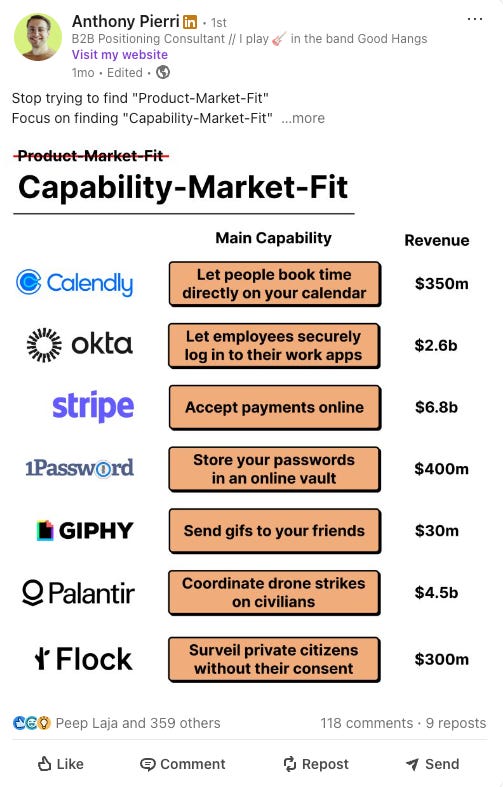
But 17 of them are contrarian, going after common advice everyone repeats.
“Obsess over customers, not competitors.” “Fall in love with the problem.” “Start with why.”
In one post he argues you should stop chasing product-market fit and look for capability-market fit instead.
Would I always recommend investing in both these formats? Yes, these are definitely two of my most recommended formats.
5. Pierri also mentions known companies in his content
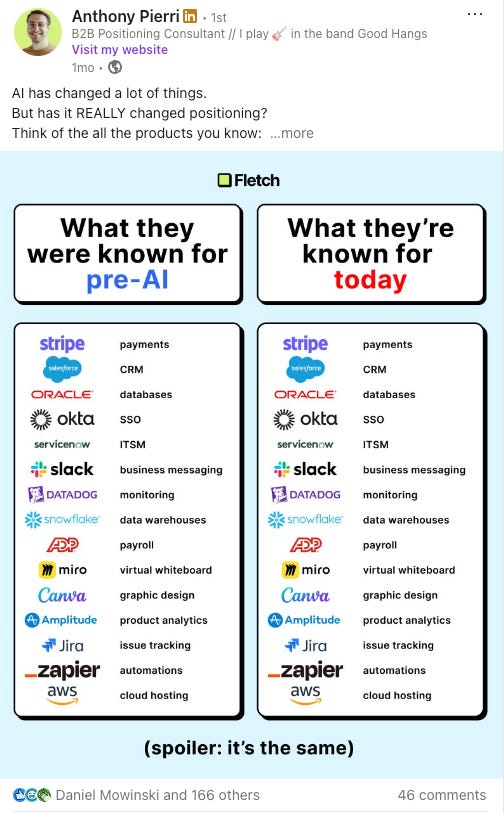
Pierri does teardowns of real companies. Gong, Clari, Attio. He’ll take a public company’s homepage and say exactly why it works or doesn’t. In this one he compares what these brands were known for before AI, and what they’re known for today.
Would I always recommend mentioning known brands? No, I think this works here because he is in the category of branding and positioning and known brands are part of that.
6. I also took notice of what Pierri DOESN’T post
What he doesn’t post is just as interesting.
Pierri posts few promotional and personal posts.
No conference photos, no “great week at SaaStr.” No client updates, no “amazing session with the team today.” No promotional posts, no “DM me,” no booking links. The only CTA is a soft mention of his newsletter at the bottom of some posts. He gives away the method, and lets the posts do the selling.
I think this is the most useful part for a regular founder. When you look at LinkedIn influencers, it’s easy to assume you have to write the cringy stuff. The personal post (”here’s what my puppy taught me about B2B marketing”). The promotional post (”apparently I made the list of top 50 B2B marketers”). Pierri skips both formats almost completely, and it still works. You can skip them too.
Would I always recommend avoiding promotional and personal posts? No, I actually recommend these formats often to founders, especially promotional posts, as they drive business results.
7. Pierri keeps his funnel simple
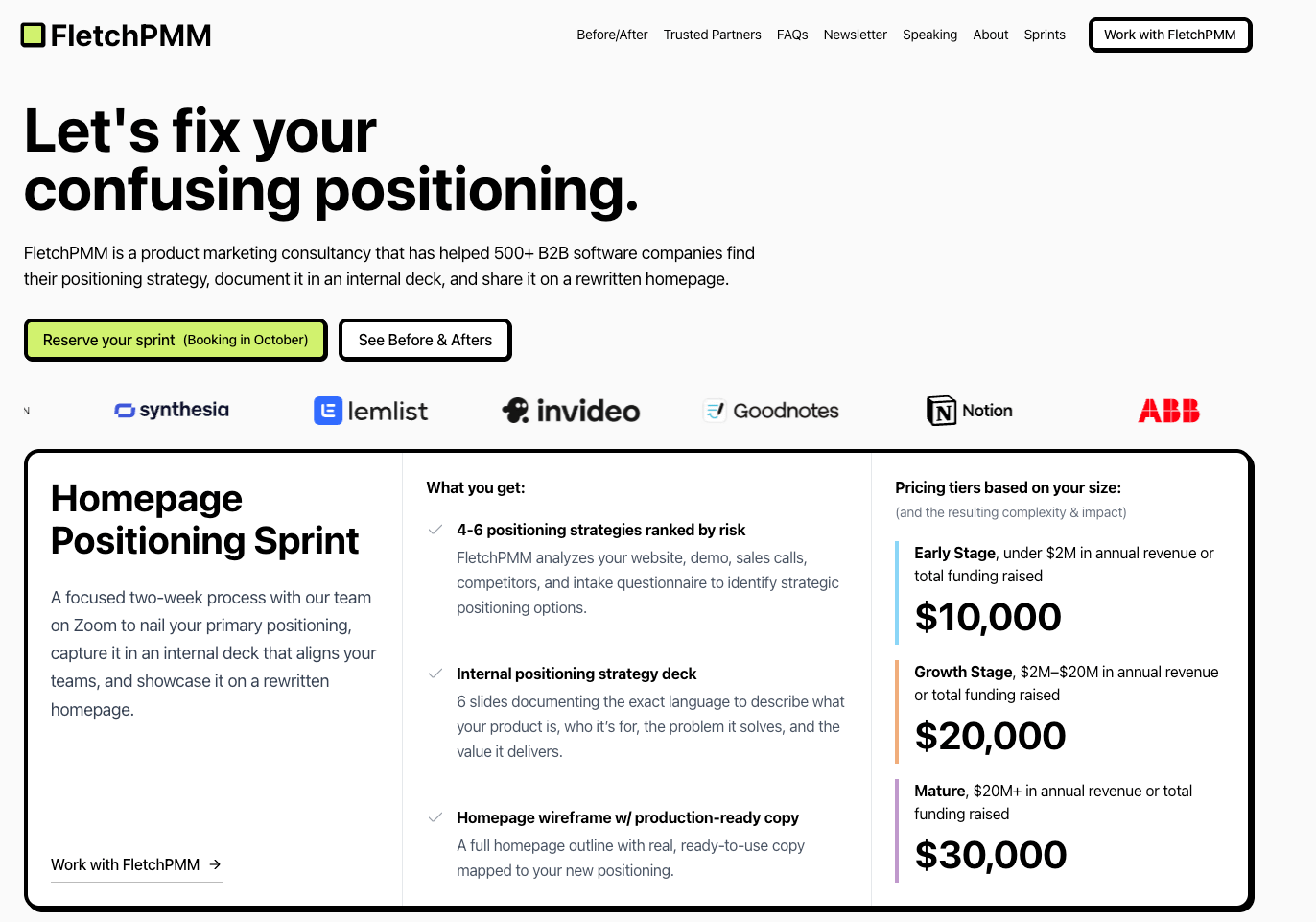
Outside LinkedIn, his funnel is simple. LinkedIn content, then a newsletter, then speaking, then the positioning service. All his prices are on the website, and so are his before-and-after case studies. And since he sells homepage positioning, it makes sense that his own homepage is great. It’s one more demonstration of the thing he’s selling.
Would I always recommend a simple funnel like his? Indeed. In fact, my funnel is pretty similar.
I hope you’ve enjoyed this analysis. Let me know who you would like me to cover next.