


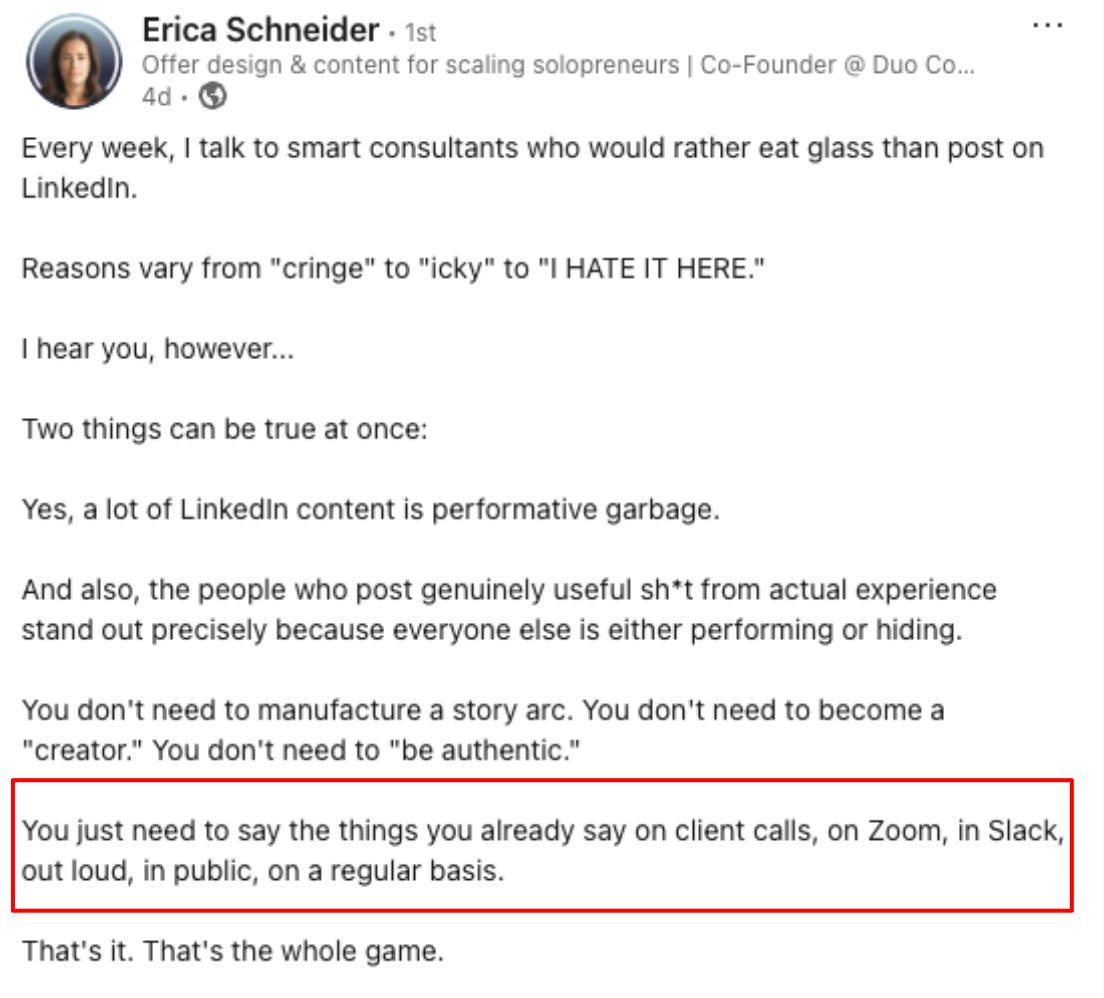
This week something Erica Schneider wrote got me thinking. She wrote about what it takes to create great content on LinkedIn:
“You just need to say the things you already say on client calls, on Zoom, in Slack, out loud, in public, on a regular basis.”
Working with clients, I know this formula of publishing content about your work week doesn’t necessarily run smoothly. When you try to apply it, you hit a wall. A writing wall.
That wall happens because your week seems boring and uninspiring.
This week I want to share the process I use to overcome the wall.
Part 1: The problem of writing about your week
A Google Hangout window is open. On one side, a highly capable SEO professional who built an agency from scratch. On the other, it’s me. We have 60 minutes.
The client is the definition of success, but today she is empty. She had a busy week and didn’t have time to think about content at all.
We went through all the basic strategy stuff needed to produce successful founder marketing. Having a Big Idea, choosing formats, defining the ICP. Everything was set up and ready to go.
But a major obstacle remained.
He looks back, and it seems like a week of nothing but uninspiring grunt work. What should we do?
What should we do?
Possible wrong path: emulating popular creators
If you go on Alex Hormozi’s YouTube channel, and filter to the most popular videos, you get this video, with 4.4 million views:

It’s tempting to see this and say to yourself: “I should post something like this”.
But you also remember what Erica said: to attract attention, you have to share your own work. So you tell yourself, ‘I’ll just take something I did this week and repackage it as a million-dollar idea.
No, please don’t. This forces a ‘profound’ insight onto a menial task, and the result is almost always cringe content.
The 2nd possible wrong path:
The opposite approach is just as dangerous: deciding your content doesn’t have to be spectacular at all.
You sit down with me, we look at your week, and nothing seems to connect to your Big Idea. It all feels like grunt work.
When we feel behind, we start looking at our week like a hyena searching for scraps of food. This is a mistake.

Hunting for scraps automatically sets your mind into needy mode. It forces you to settle for low-quality observations because you’re desperate to fill a slot.
To find the value insights, we must tease out what the founder is actually excited to answer.
Part 2: The five maneuvers
Your week isn’t actually boring. The tre true insights are just buried. To find them, you have to slow down and look for signals in places you usually overlook.
I use these five maneuvers to find the ideas that actually resonate with you (and your audience).
Maneuver #1: What’s top of mind?
Our brain is a miracle of background processing. When a specific question, a fragment of a conversation, or a nagging thought keeps “pinging” you throughout the day, your subconscious is trying to tell you it found something significant.
If you’ve ever been through therapy, you’ve experienced that moment of surprise when a seemingly random “top of mind” topic unspools into a deep, meaningful realization. Content works the same way. That “ping” isn’t a distraction; it’s a signal that you’ve stumbled onto a perspective or a problem that actually matters to you.
If something pops up, we write it down. Exploring if it resonates only comes later. For now we are collecting the potential ideas.
Maneuver #2: What we saved
If we are diligent, we’ve already jotted down notes as things happened during the week.
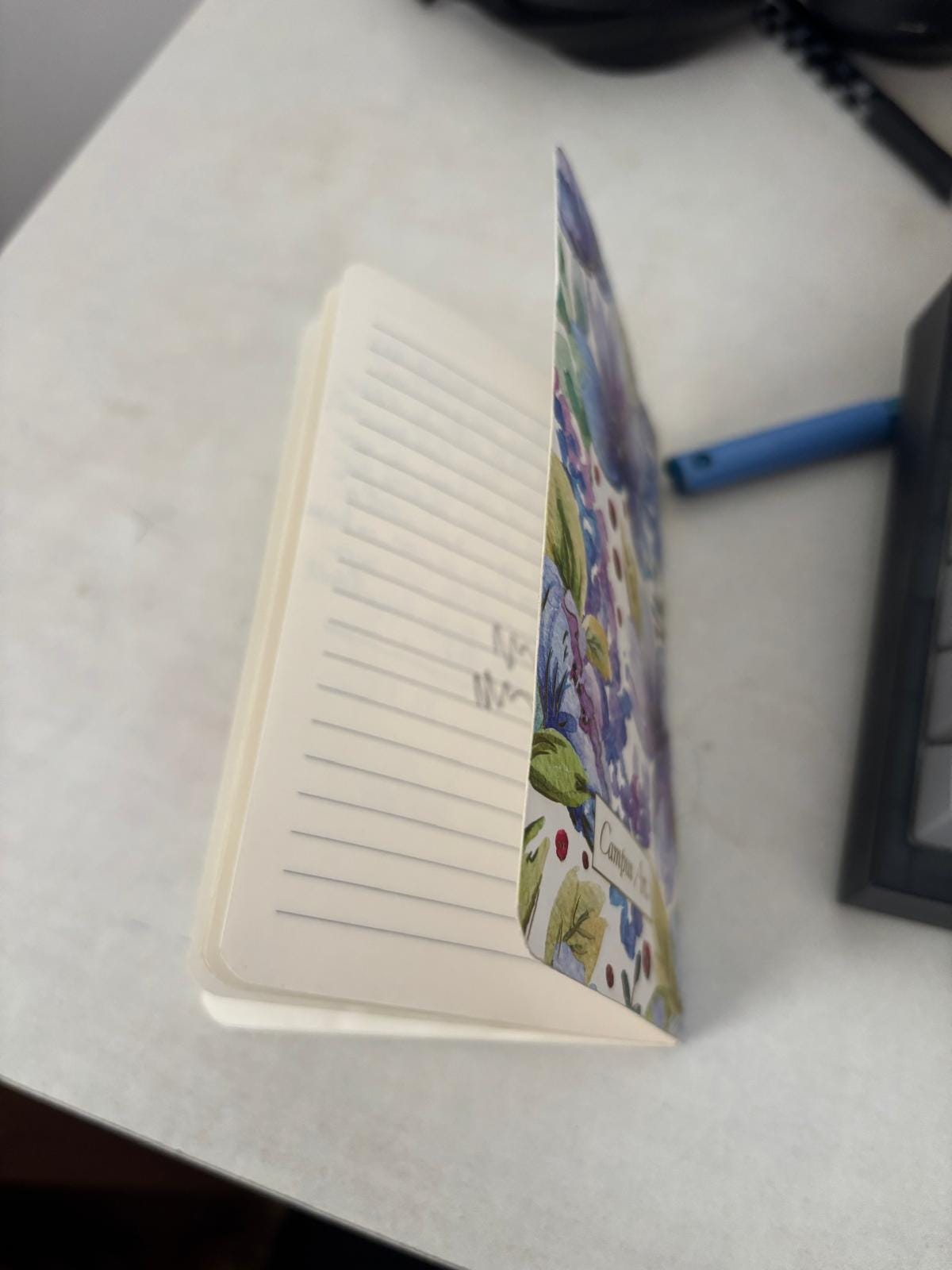
I always carry a paper notepad. These aren’t polished ideas. A phrase a client used, a sudden realization during a commute, or a note to self after a tough meeting.
When you sit down to write, these artifacts act as a bridge back to the mindset you were in when the insight was fresh.
Maneuver #3: Looking at signals
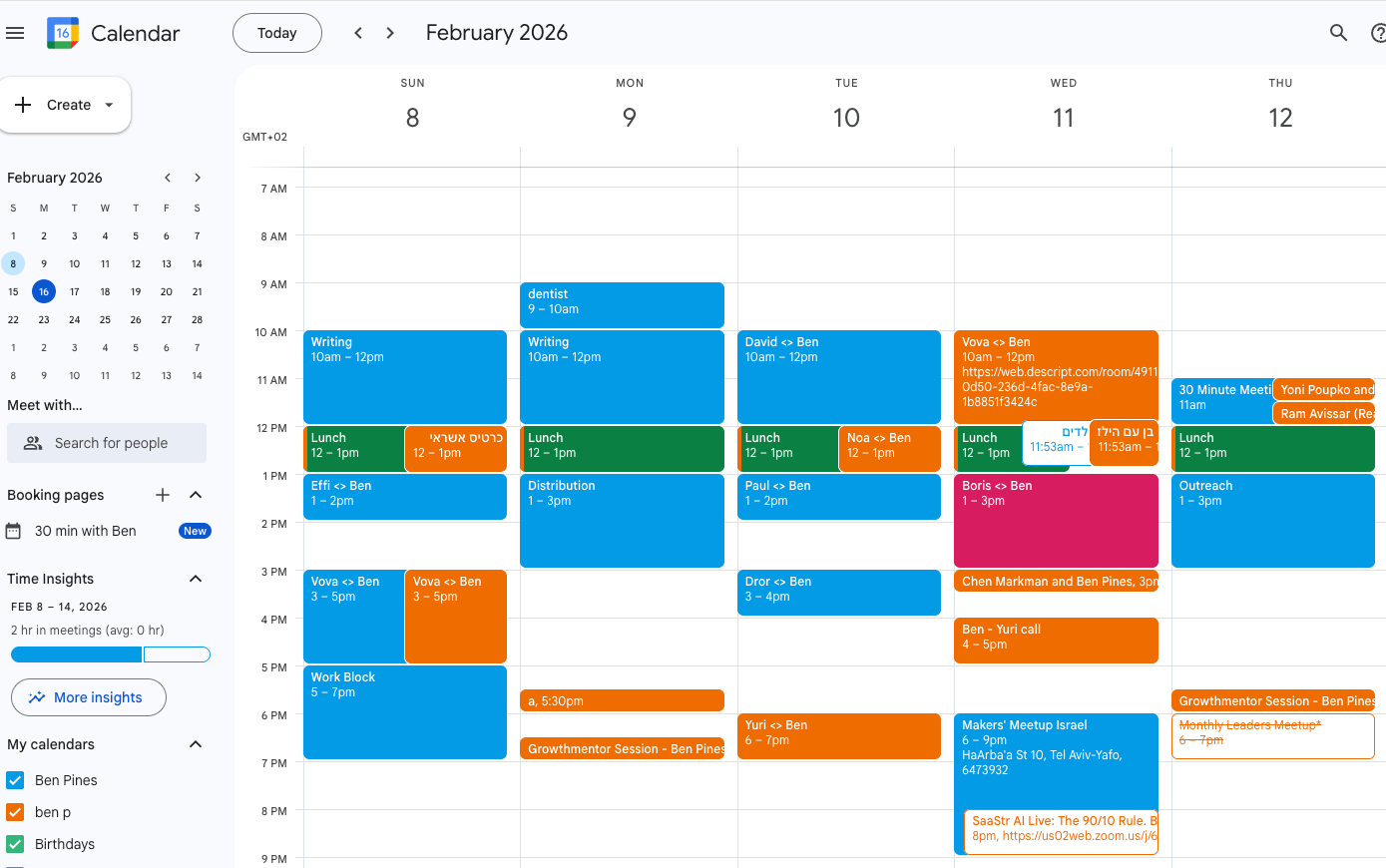
If the first two maneuvers fail, I have my clients look at their calendar, sent emails, Google Docs, and task management systems.
Don’t just look for what you did, look for where the heat was.
Sent Emails: Which reply took you 20 minutes to craft because you were explaining a complex concept?
Calendar: Which meeting left you energized or frustrated?
Task Manager: Which grunt work item actually required a high-level SOP to complete?
Our work always leaves a trail, you just need to take on the role of investigator and follow the clues.
Maneuver #4: The diagnostic questions
When the trail is cold, I use a specific set of prompts to shake an idea loose.
The Context: What happened this week? Were you out of the office or in a different environment?
The Conflict: What was the biggest challenge you faced? Did you have to dust off an old SOP to solve it?
The News: Did something happen in the news that made you look at your work differently?
The Wins: Was there a notable breakthrough for you or a client?
The Question: What is the one question you were asked more than once this week? If three people asked, three hundred probably want to know.
These questions are broad by design. They are meant to spark a memory of a conversation you otherwise would have dismissed as just work.
Maneuver #5: Personal interest (what do you actually care about?)
This is the most important filter. Is there a topic that’s been simmering in the back of your mind? Maybe it’s a frustration with an industry trend, a new hypothesis about your customers, or a shift in how you want to run your business.
If you don’t care about the topic, your reader won’t either. This maneuver gives you permission to ignore the grunt work of the week and focus on the intellectual work that actually excites you.
Part 3: Evaluating the topics
Once a topic surfaces, for example, “Last week a client kept arguing over the price”, we have to qualify it. We want to ensure it’s not just a chore or a complaint, but a strategic piece of content. We run it through three filters:
How does this relate back to your Big Idea?
How does solving this help your business or your clients?
What do you personally find interesting about this?
Previously, I used a simple diagram to show the overlap between your Work and your Content. But I realized that was incomplete.
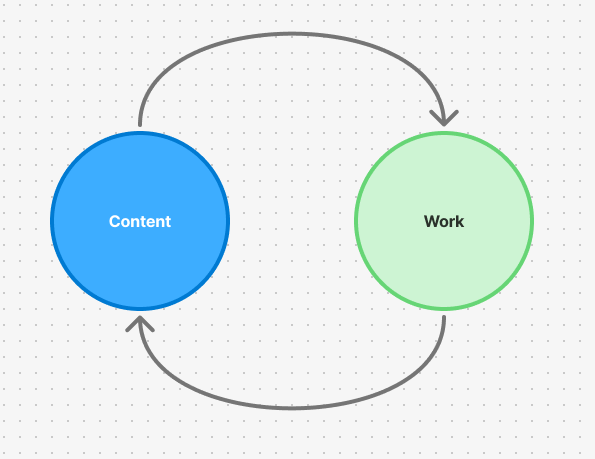
In actuality, there is a third middle circle, your interest:
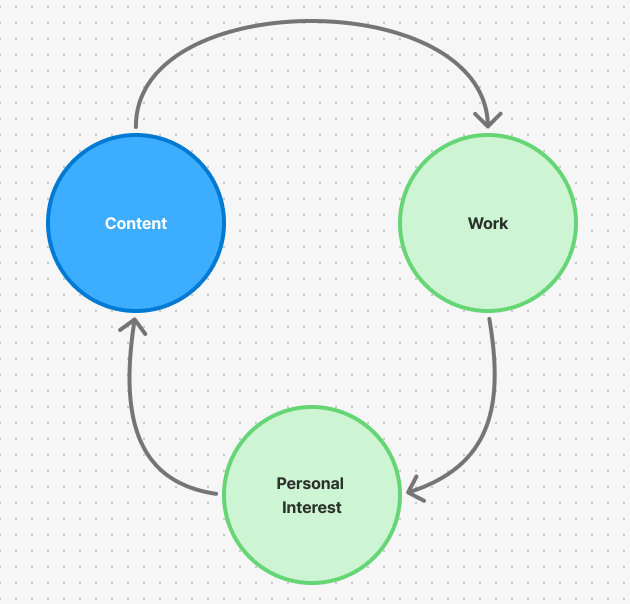
If you look at the experts making it big on LinkedIn, they all share one trait: relentless curiosity. It’s apparent in every post they share.
The stand up analogy
I recently revisited a video of Louis C.K. discussing the trap of the modern creator. He describes two old ways of working: obsessing over your work (your voice) or obsessing over the audience (fame). But now, there is a weird third way: obsessing over an artificial brain ( the algorithm).
He argues that we’ve moved away from “what do people like” toward “how do I get this artificial brain to spread me to people who don’t give a shit.”
He says:
“You understand what you’re doing with this algorithm is you’re trying to get the attention of an artificial brain. It’s a really weird Endeavor [..] to obsess about this.”
I’m not a stand up comedian, but if I were coaching a newbie comedian to find their voice, I’d do three things:
Extract the raw observations from their life.
Help them find the angle for each joke.
Most importantly: I’d ask them, “Do you find this funny?”
That’s what I do with founders, ask them if they find it interesting, and why.
To be a voice worth listening to, you have to Say Something You Care About.
If a topic feels “right” or “important” to you, it’s usually because it serves a deeper purpose:
Writing and thinking about the issue helps you explain a concept to future clients.
It articulates exactly why your service is valuable.
It presents a new hypothesis you want to test in the market.
It’s a cool concept that reinforces your Big Idea.
Any one of these points can happen when you explore a topic you find interesting. You skip over them if you just try to “get more likes”.
The power of obliquity
The obliquity idea, popularized by economist John Kay, proposes that complex, long-term goals, such as profitability, happiness, or success, are often best achieved indirectly rather than through direct, rigid pursuit.
In content marketing, this means stop asking, “Will this perform well on LinkedIn?” and start asking, “Is this idea worth thinking about?”. When you treat content as a tool for exploration, you serve your own curiosity. Ironically, that curiosity is exactly what attracts an audience.
Back to the boring week
Maybe your week really was a slog. Maybe you ran through the five maneuvers and still came up empty. That’s okay. Have a rainy day folder of evergreen topics or successful past posts you can repurpose.
But here is the real win: you went through the process. You looked at your work, interrogated your calendar, and gave your expertise a chance to speak.
That mental exercise is a strategic victory. It’s a thousand times better than skimming the news and deciding to publish another generic post about using Claude Code just because “everyone is talking about it.”