

Is LinkedIn a good channel for micro-SaaS founders?
It’s a question most solopreneurs can’t get a clean answer to, and the reason is that the available models sit at two extremes.
On one end, the media-native operators: Marc Lou, Pieter Levels, Justin Welsh. Indie hackers who turned audience-building into the product itself. Their advice is useful, but they’re a specific archetype. Their distribution is the business. The audience came first, the products came later.
On the other end, the enterprise SaaS playbooks: Lenny, the PLG newsletters, the GTM thought leaders. Useful at scale. Mostly irrelevant when you’re at $0–$5M ARR with a team of three.
The middle is empty. There’s almost no serious study of how an actual micro-B2B-SaaS founder works. Someone who built a product first, sold it on its merits, and only then figured out distribution,and uses LinkedIn to grow reach without making content their main job.
This is what brought me to Marie Martens.
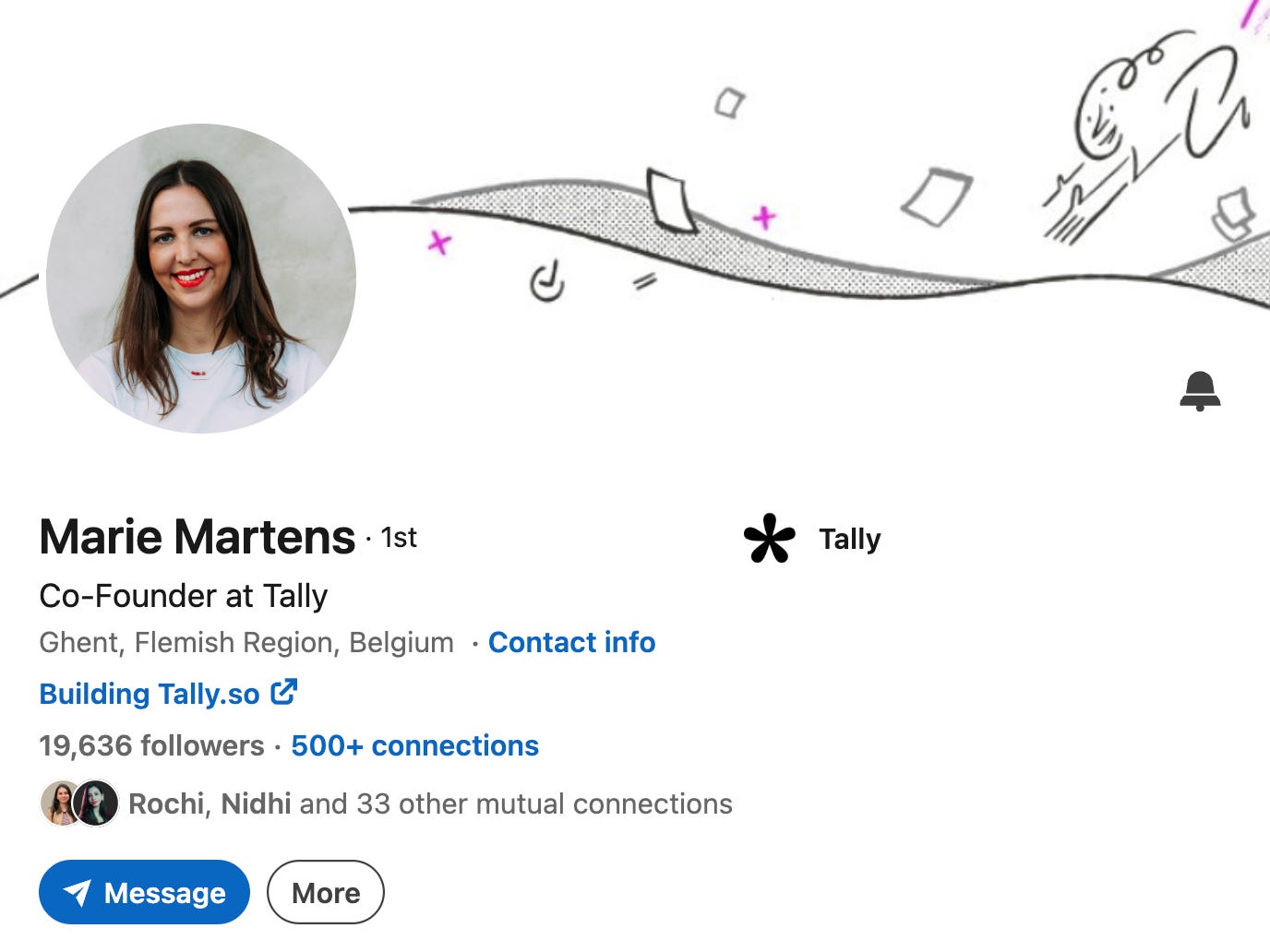
Marie is the Belgian-born co-founder of Tally, a popular, user-friendly form builder. She and her life partner, Filip Minev, bootstrapped the company.
She’s interesting precisely because she fits neither archetype. She didn’t build an audience first. She didn’t have an enterprise marketing budget. She built a product, then figured out posting alongside it. Which is exactly the situation most micro-SaaS founders are actually in.
She’ll tell you, repeatedly, that Tally’s growth is product-led. AI search drives 35% of new signups. The Tally badge at the bottom of every free form is the growth engine. The product is the moat.
The story Marie doesn’t tell about herself
Preparing for this article, I watched five different interviews Marie gave over the past two years. In all of them she mentions PLG. In none does she mention LinkedIn.
But look closer at her LinkedIn, and a second story emerges. Over roughly four years, she went from a corporate marketing manager posting Dutch event announcements with a few dozen reactions to a bootstrapped founder whose posts routinely break 1,000, and occasionally 8,000.
She did this without becoming a content creator. She didn’t pivot to teaching. She didn’t launch a course. She didn’t build a personal brand newsletter. She just got dramatically better at one specific thing: writing LinkedIn posts that made other people care about a form builder.
If you’re a micro-SaaS founder who doesn’t want to become a media business, Marie’s path is the closest thing we have to a replicable model. She figured out the minimum viable founder-led content motion that actually compounds.
One honest caveat before the playbook: Marie’s formats are replicable. Her outcomes aren’t fully replicable — Tally is at $5M+ ARR, riding an AI-search tailwind that’s hard to manufacture. But the formats came first. They’re what got her in position to capture that tailwind when it arrived.
Before getting to the formats, it’s worth understanding how she got here. Because Marie’s LinkedIn didn’t always look the way it does now.
The four eras: how Marie’s posting actually evolved
If you scroll back to 2014, Marie’s LinkedIn is unrecognizable. The progression is not always linear or necessarily logical, but it is interesting to observe.
Era 1: Regular LinkedIn poster (2014 – 2020)
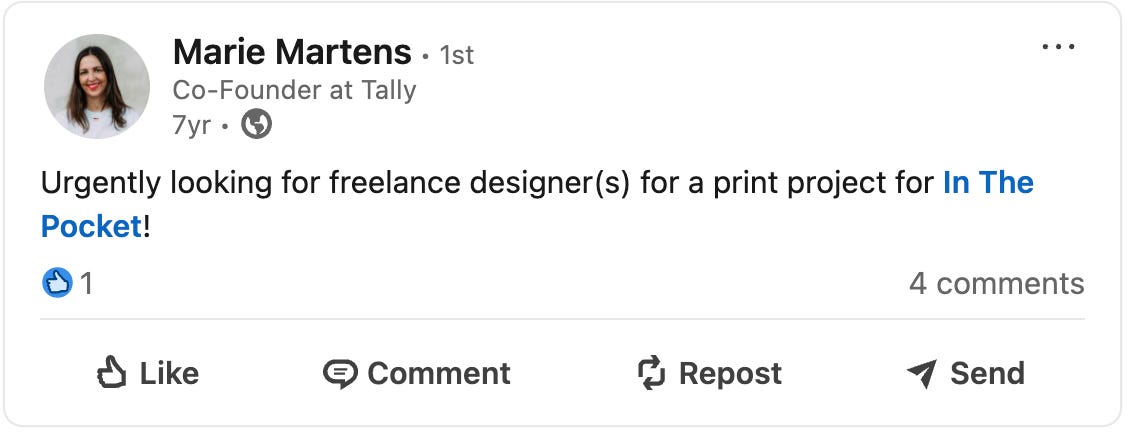
Marie is a marketing manager, before Tally. Engagement sits in the single digits, occasionally cracking 40 reactions. When Tally's MVP launches in August 2020, that first post gets 74 reactions. Meaningful by her standards at the time. Invisible by today's.
Era 2: The build-in-public founder (2020 – 2022)
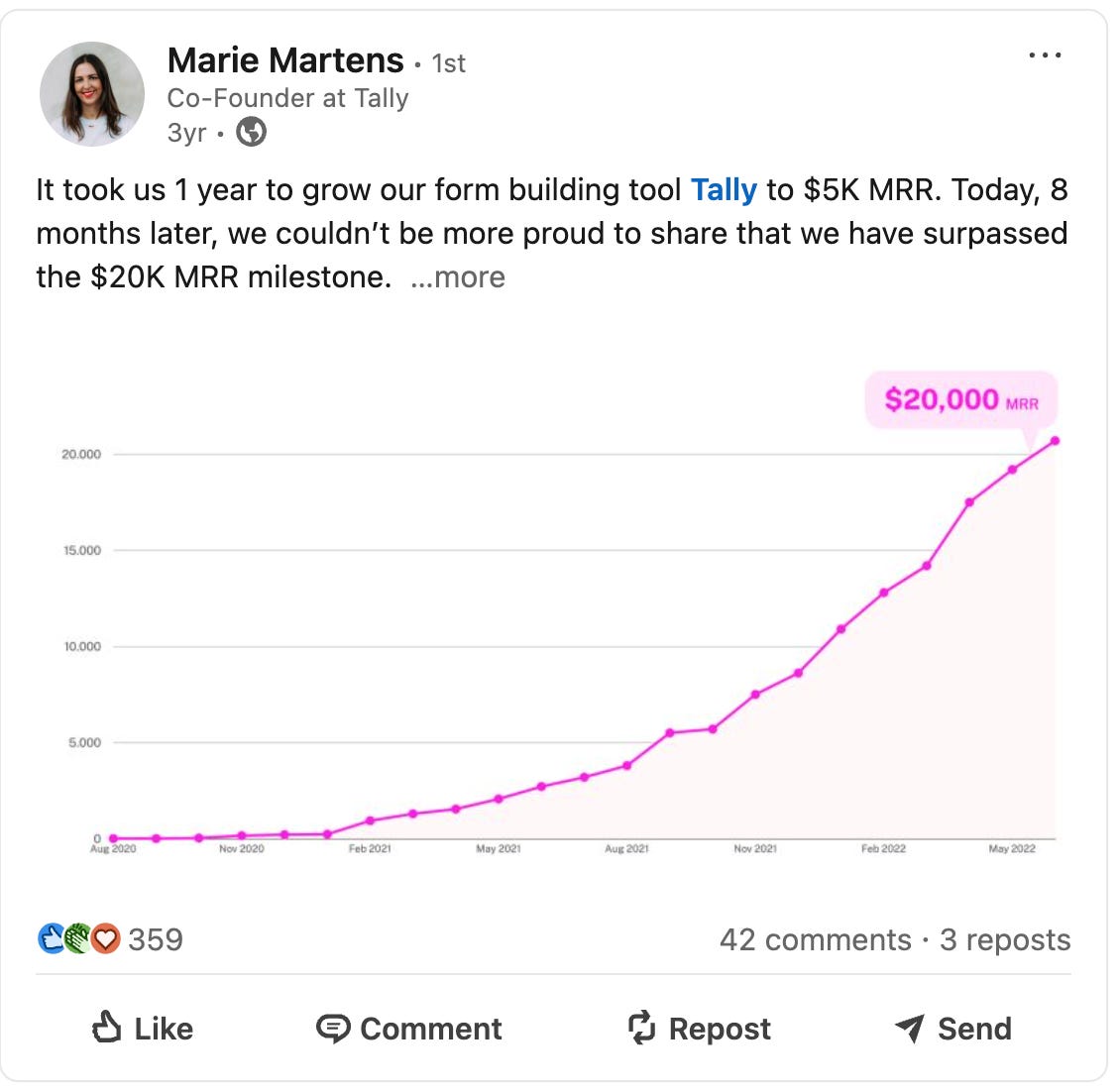
This is where the milestone post format first appears. The "Year 1" retrospective in mid-2021 (~169 reactions). $20K MRR in early 2022 (~359). The audience is small but compounding. The strategy: numbers-led transparency, every round number earns a post and becomes clearly visible across this stretch.
Era 3: Adding personal voice (2023)
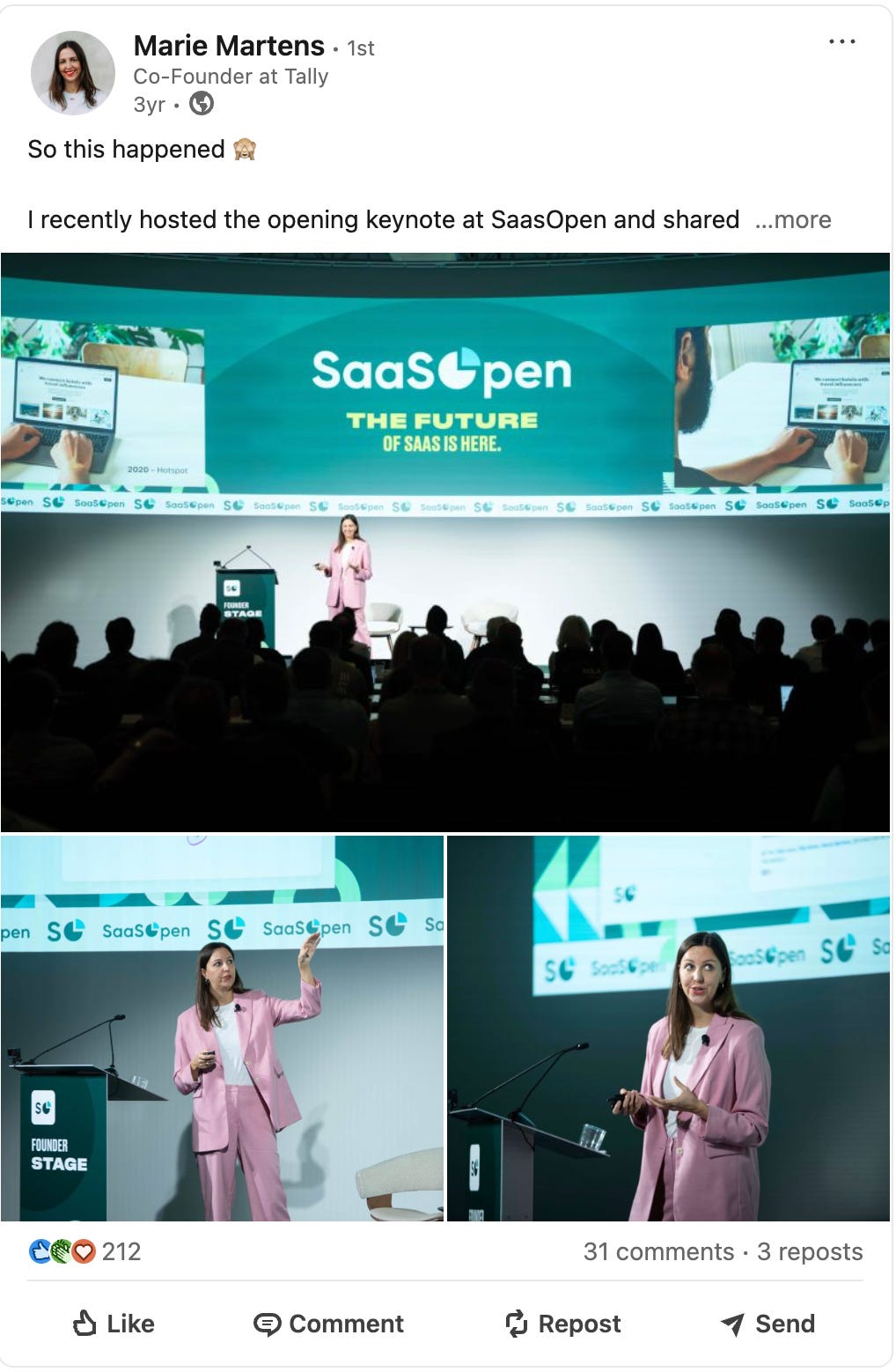
Something shifts. Marie starts posting things that aren't tied to a number. Reflections on building, on partnership, on small product decisions. The voice is now recognizably hers, not a company channel.
Era 4: Adding category voice (2024 – now)
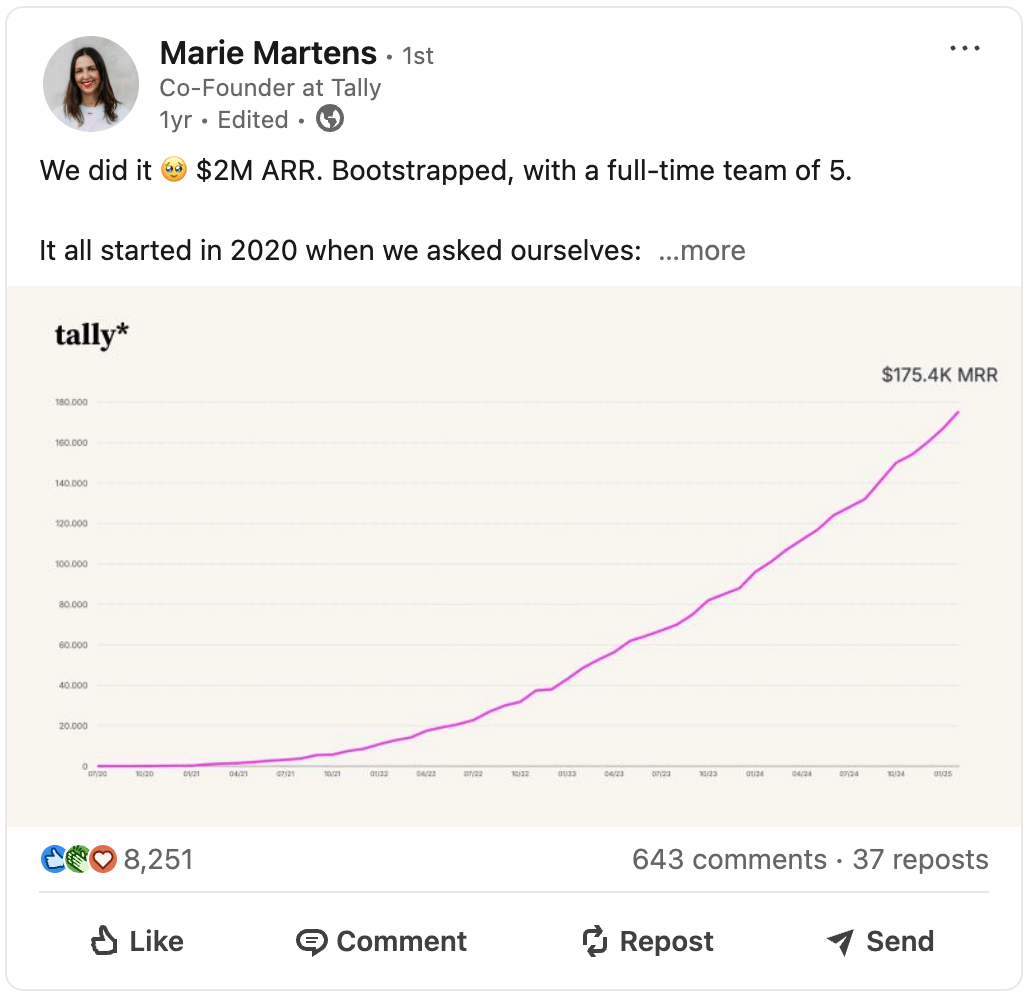
Marie notices something most B2B founders haven’t: ChatGPT and other AI search tools are driving a meaningful share of Tally’s new signups. She starts documenting it with charts, data, and interpretation. The “$2M ARR” post breaks 8,000 reactions, her first true viral breakout. The $3M ARR post lands at 1,676. HubSpot, Lenny Rachitsky, and Vercel start citing her as a reference point for “calm, AI-native, bootstrapped.”
Analyzing the progress across eras
Marie goes through a real change, that reflects how far her startup has progressed. She starts by reporting facts → then interpreting facts → then holding and sharing a worldview. Most micro-SaaS founders try to start at the worldview. Marie earned hers across four years and roughly 250 posts.
Now to the formats. There are seven she returns to repeatedly. Together they cover the large majority of her posts — I reviewed about 200 of her last few years and these patterns kept surfacing.
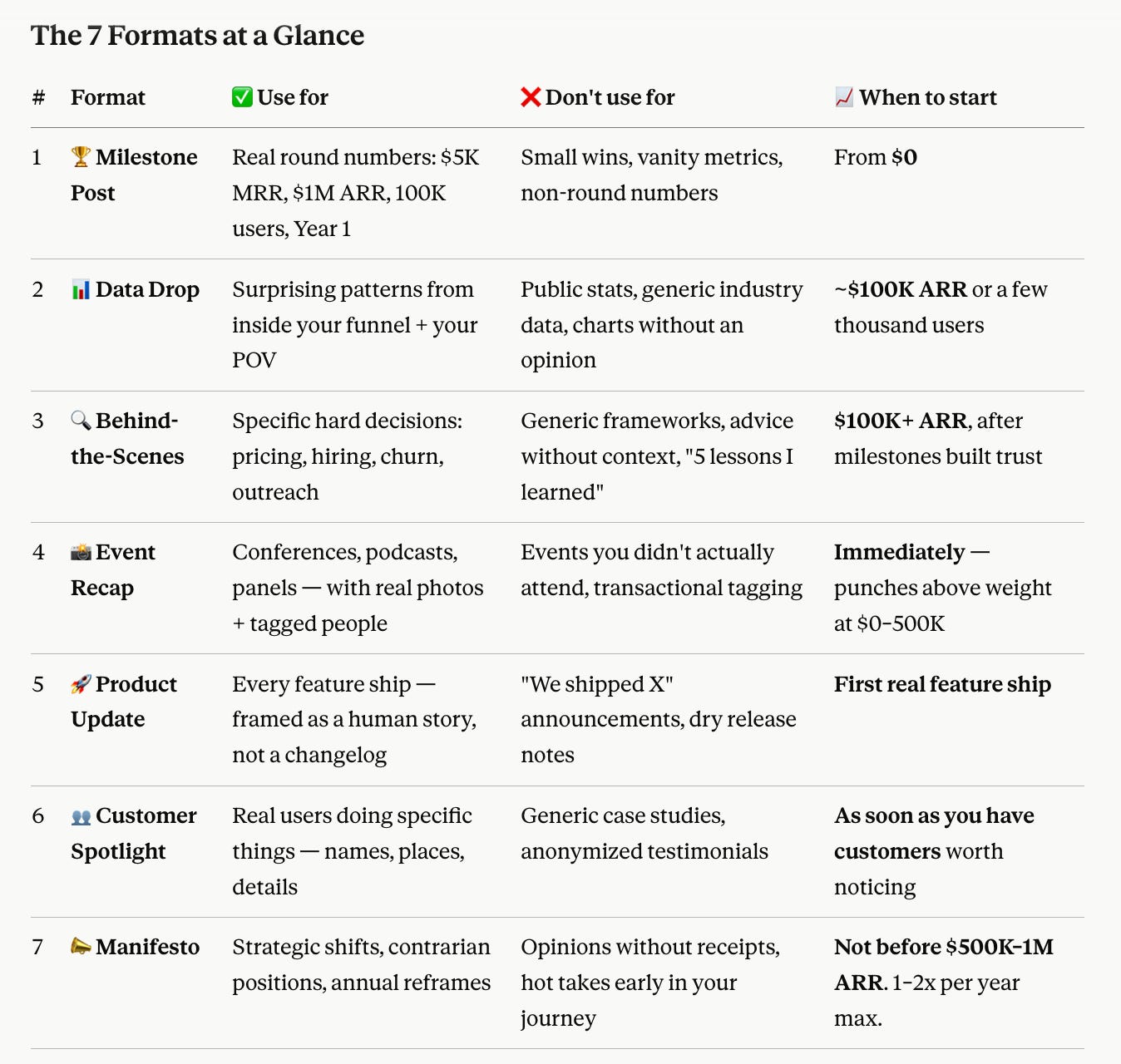
Format 1: The Milestone Post
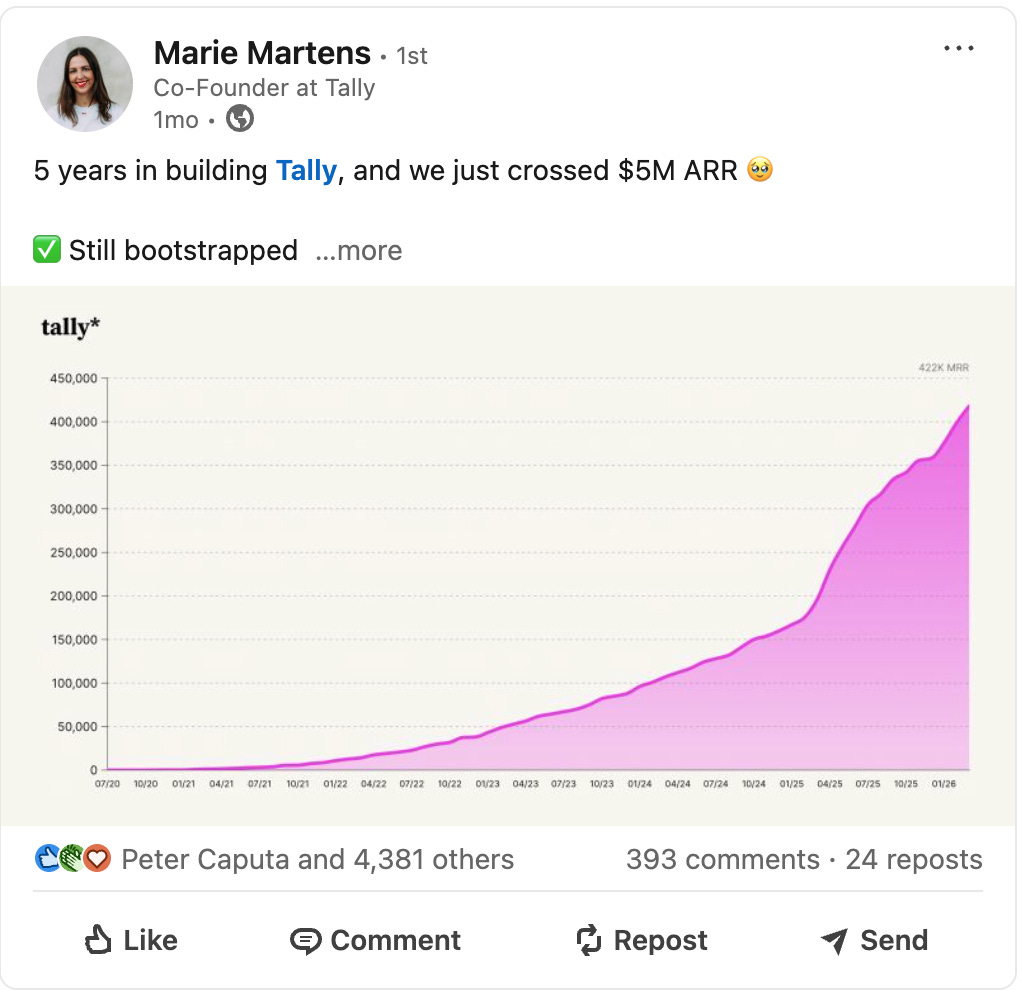
Her $5M ARR post broke 4,000 reactions. The format is identical to her $5K MRR post from three years earlier. That repetition is the entire engine.
Marie posts this format at every meaningful threshold: revenue (from $5K MRR up to $5M ARR), users (from 10K to 1M), anniversaries, retention numbers.
Use it for: any genuine threshold. Revenue, users, retention, team size, anniversaries. Don’t dilute it on small wins. Save it for real round numbers, then write the post the same way every time. The repetition is the point. Readers learn the shape and start looking for the next one.
Why it stops the scroll: This is social proof. It starts with a strong hook. “We reached $XX, want to hear how we did it?”
When to add it: From $0. This is the first format every founder should master. At $0–500K ARR your numbers are small but real, and the bootstrapped story is at its most compelling here. “$5K MRR with a team of 2” is more interesting than “$5M ARR with a team of 100.”
Format 2: The Data Drop
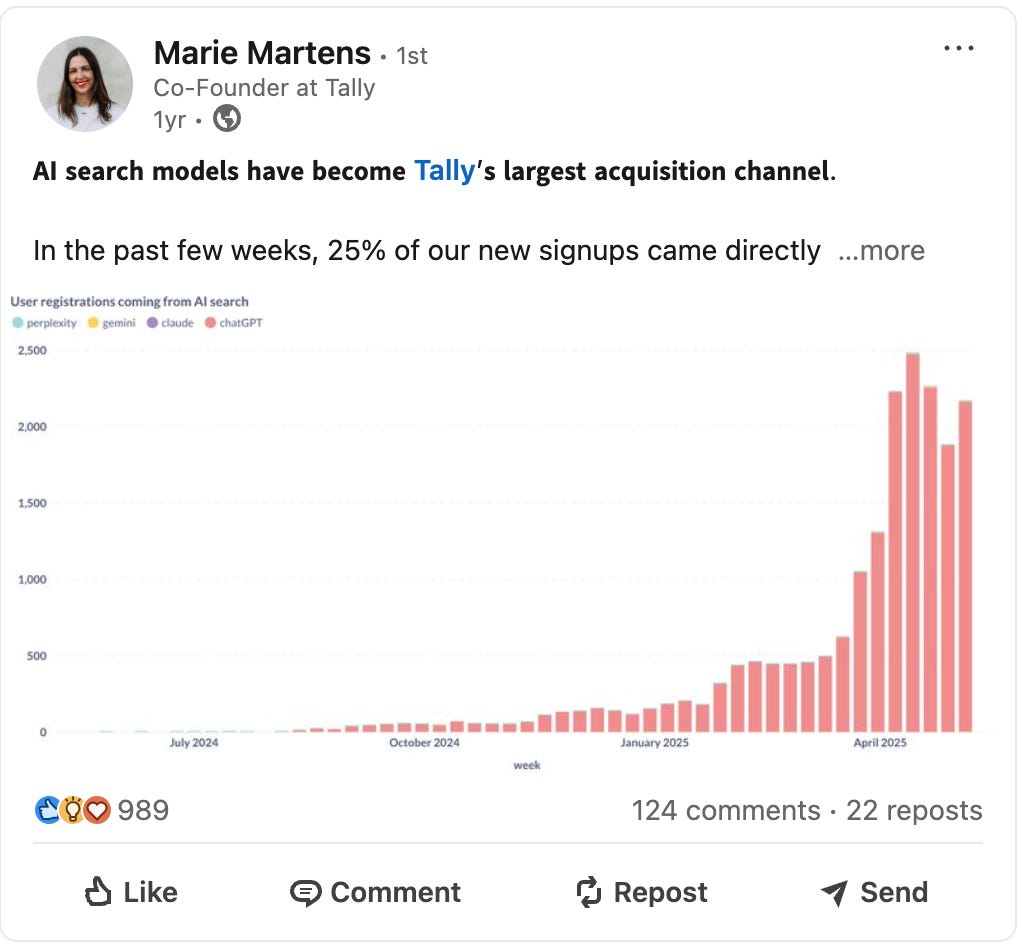
When Marie has proprietary data nobody else has, she posts the chart and lets readers do the work. She’s been quietly documenting Tally’s AI-driven signup growth since mid-2024, well before most B2B founders had noticed the shift.
This post hit 989 reactions and became one of the most-cited pieces of evidence in the broader GEO conversation. It worked because Marie had data nobody else did.
The key distinction from a milestone post: this one isn’t about Tally’s growth. It’s about what Tally’s growth reveals about the world.
Use it for: any pattern you can see from inside your product that outsiders can’t. Onboarding survey results, acquisition mix shifts, retention curves, feature adoption rates, refund reasons. If you have a metric that surprised you, it will probably surprise your audience too.
The discipline here is restraint. Don’t post the data without a point of view. Don’t post the point of view without the data. Both together is what makes the post unfakeable.
Why it stands out from AI: Data takes effort. Digging into stats, and using human discretion and maybe a professional analyst to figure out what is meaningful enough.
Why it stops the scroll: Specific, surprising statistics. “25% of signups from ChatGPT” violates the reader’s mental model of how customers find SaaS products. Cognitive surprise is the fastest scroll-stop on LinkedIn, faster even than emotion.
When to add it: From the moment you have enough data to be worth interpreting. Realistically $100K ARR or a few thousand active users. Below that, your sample size is too small and the numbers won’t carry.
Format 3: The Behind-the-Scenes Reflection
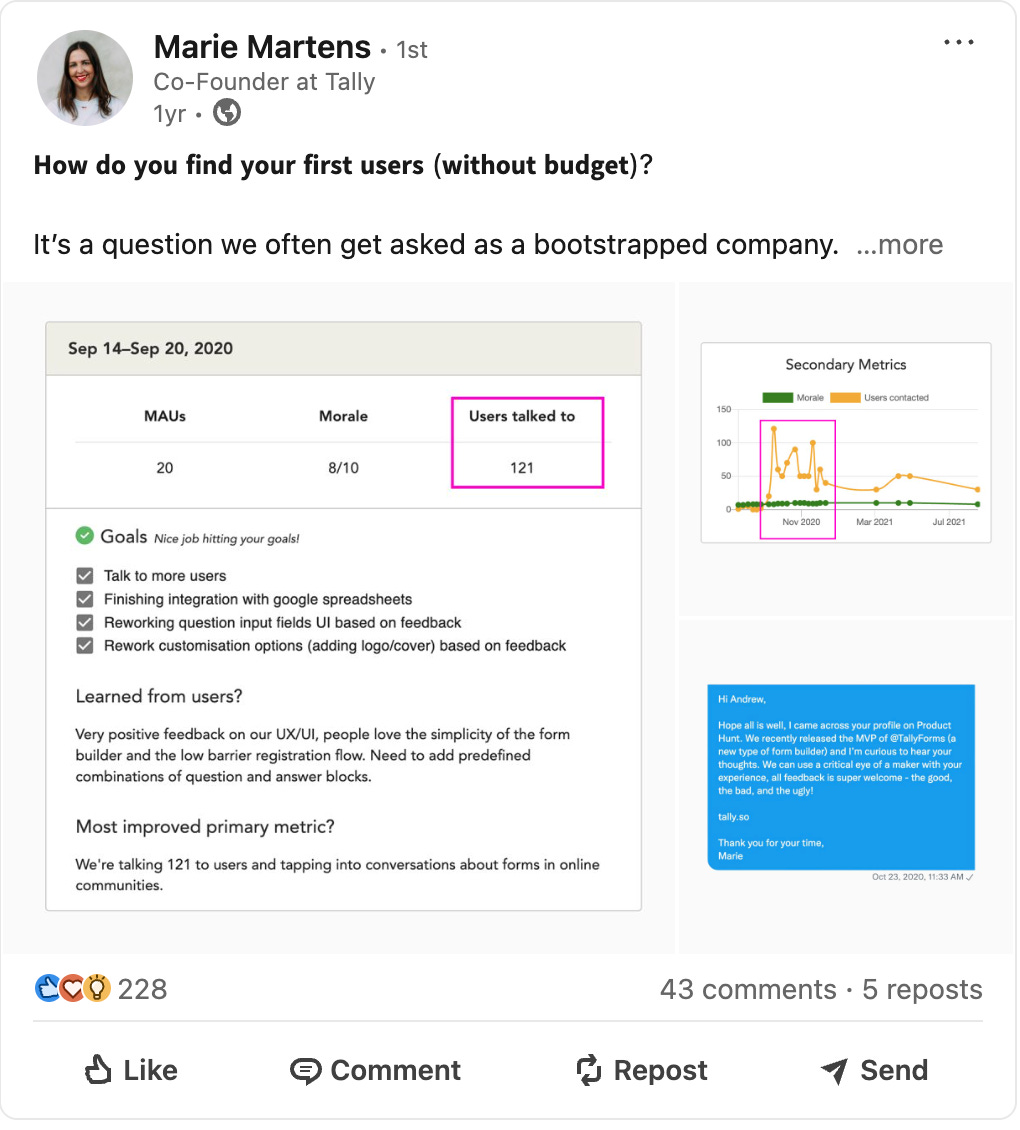
These posts pull back the curtain on something specific Marie did.
The structure is consistent: situation → constraint → action → what worked → what others can take from it.
These posts compound differently than milestone posts. A behind-the-scenes reflection is an evergreen reference that gets shared in DMs and saved for later.
Use it for: any time you’ve done something other founders would want the playbook for. Cold outreach, first-customer acquisition, hiring your first employee, pricing changes, churn investigations. The harder the problem and the more specific your answer, the better the post.
Why it stands out from AI: The company you run takes shape according to your decisions. These decisions (hopefully) have your unique perspective behind them. Since you are invested in your business, when you share what you are doing with your audience, they know you have more skin in the game than AI. If you fail - your business fails.
This is a pretty tricky format, since it is hard to prove that the insight you are sharing is really yours. This is why this format is different than other formats, since it relies on your audience trusting what you share, trusting that if you share something, you’re really behind it.
Why it stops the scroll: Like we just mentioned, this format only stops the scroll if your audience trusts you, and that happens over time.
When to add it: This really depends. When you’ve already passed $500K ARR, the trust comes to you naturally from the achievement. It really depends how soon you can invoke trust with your audience and use that currency to get their attention.
Format 4: The Conference / Event Recap
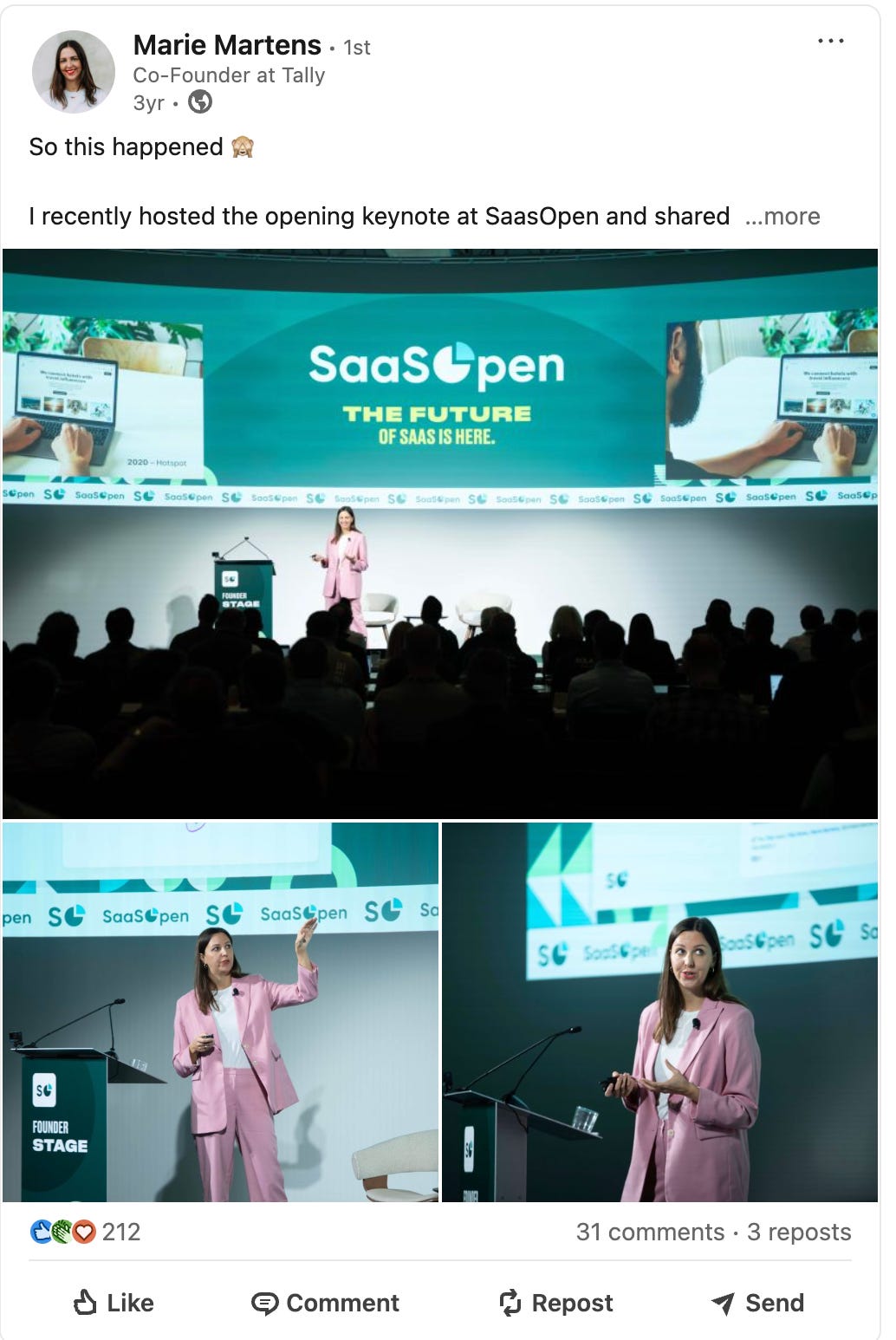
Marie attends a lot of events. Each one becomes a post with the same structure: a photo carousel, a short reflection, named people tagged. The post isn’t really about the event, it’s a reason to be visible alongside other respected operators in her space.
These posts almost always hit 200–500 reactions because they’re reshared by everyone tagged. The math is simple: if you tag five operators with 30K followers each, your post has 150K potential second-degree distribution before LinkedIn’s algorithm even gets involved.
Use it for: conferences, podcasts, panels, customer meetings, even small meetups. The post extends the half-life of the event from one day to one week, and turns a single appearance into ongoing network capital.
The discipline: actually tag people. Specifically. By full name. With genuine reasons. The post falls flat if the tags feel transactional.
Why it stands out from AI: AI cannot attend events (not yet at least).
Why it stops the scroll: Photos. Almost every event recap leads with a photo of Marie on stage or with attendees, and faces stop scrolls faster than text on LinkedIn.
When to add it: As soon as you’re going to events worth posting about.
Format 5: The Product Update
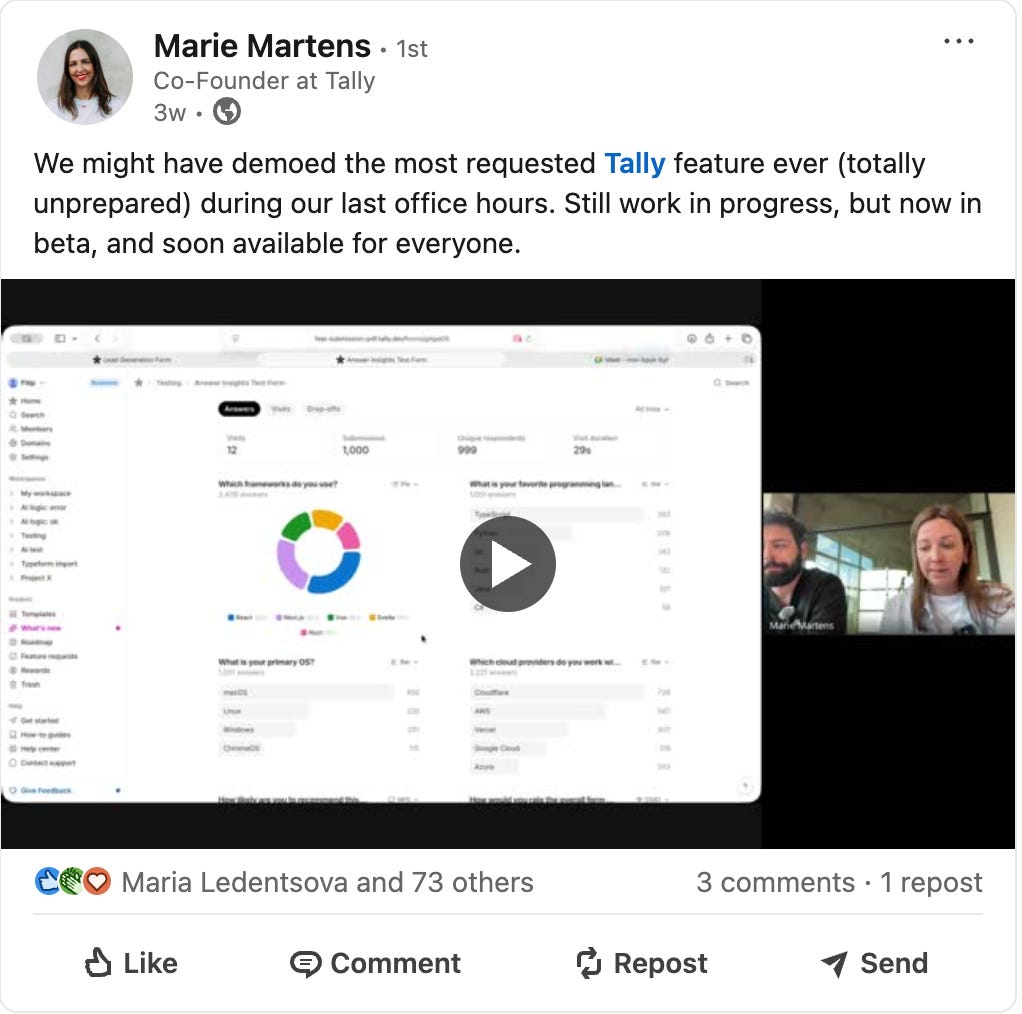
Marie almost never posts “we shipped X.” She posts the story of why X happened, with the feature as the punchline.
“We might have demoed the most requested Tally feature ever (totally unprepared) during our last office hours. Still work in progress, but now in beta, and soon available for everyone.”
Or:
“If you’ve ever rage-tapped a dropdown on mobile… this one’s for you 😅 Small but meaningful mobile UX upgrade.”
The post is about the human moment around the feature.
Use it for: every feature launch.
Why it stands out from AI: Finding the hook the audience will connect with, like Marie does for every feature, is the way to differentiate it from AI content.
Why it stops the scroll: Beyond the specific way Marie delivers the feature releases, in general these posts get more traction because people want to get new features. It’s like getting presents.
When to add it: From your first real feature ship.
Format 6: The Customer / User Spotlight
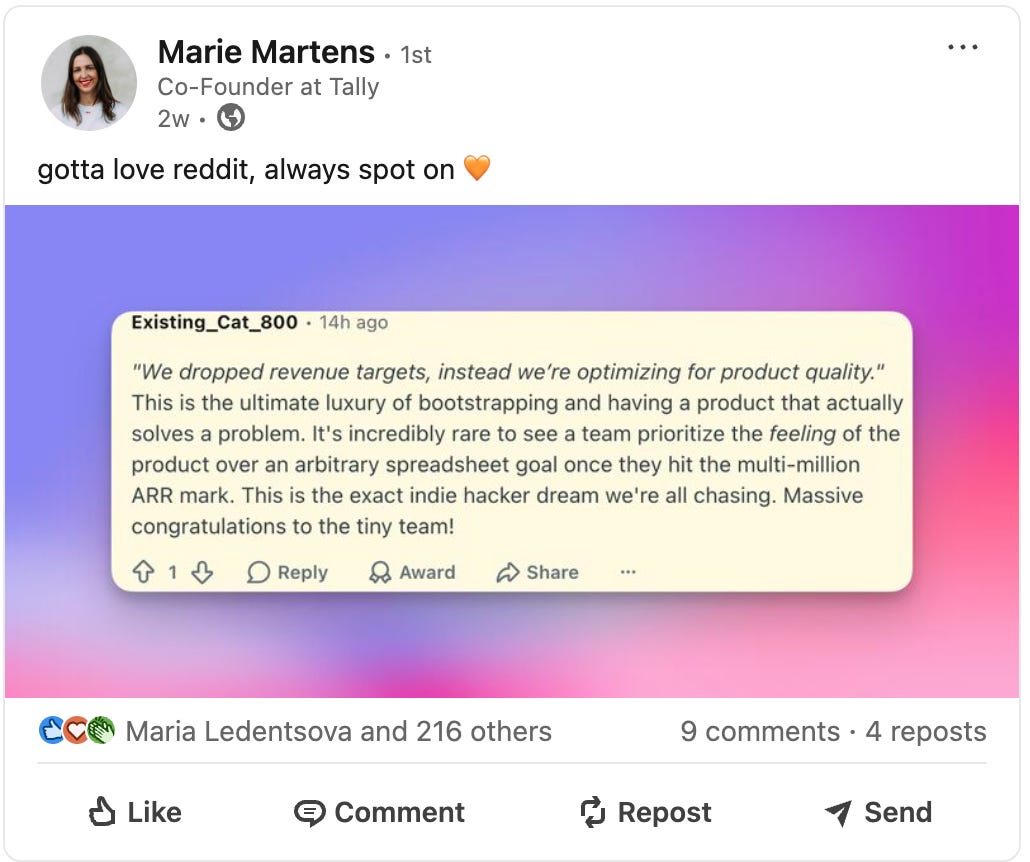
These posts make a customer the hero. Marie does this constantly, sharing what users have built with Tally, quoting feedback emails, highlighting community-organized events.
Use it for: any meaningful customer moment. Resist the temptation to make it a case study. Make it a portrait of the person.
Why it stands out from AI: These posts are social proof, and they connect us with the human end user who is real.
Why it stops the scroll: Real names in real places doing real things. “90 people signed up at Taraba State University in Nigeria” is specific, surprising, and human in a way generic content rarely is.
When to add it: As soon as you have customers doing things worth noticing, which is earlier than most founders realize.
Format 7: The Manifesto
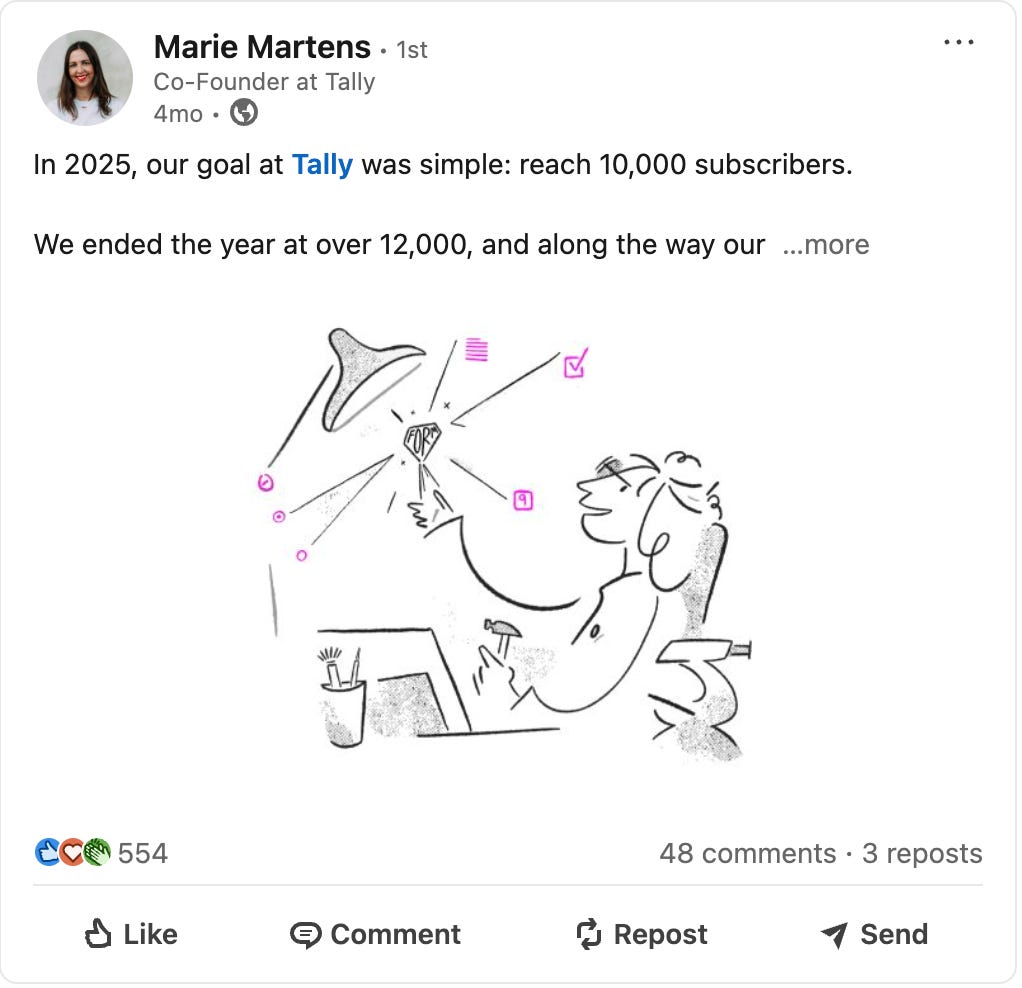
These are the rarest and highest-impact. Marie writes one maybe every three to four months. They’re long, opinionated, and stake out a position.
The 2026 strategy post is the canonical example. The post broke 500 reactions and reframed how a lot of people in her network think about company-building.
The manifesto works because she earned the right to write it. You can’t open with a manifesto when nobody knows who you are. But after 18 months of milestone posts and data drops, the audience is ready for the worldview.
Use it for: strategic shifts, annual reflections, major reframes. Once or twice a year, not more.
Why it stands out from AI: AI can write opinion posts all day, but they read as hollow because there’s no track record behind them.
Why it stops the scroll: A confident, slightly-against-the-grain stance in the first paragraph (”So in 2026, we won’t have a revenue target”). Contrarian-but-defensible positions trigger pattern-interrupt: the reader thinks “wait, no revenue target?” and has to read further to find out why.
When to add it: Not before $500K–1M ARR, and even then sparingly.
The other 20%
The remaining 20% is a mix of smaller, lighter shapes that round out the rhythm.
The photo dump, a year-in-review or trip recap with 8–10 images and a numbered list of moments.
The meme or screenshot reaction, often a Reddit thread about Tally or a piece of fan art, posted with one line of commentary.
There are podcast and press feature shares.
There are quick wins. Small product nods, a screenshot of a kind user email, a reaction to industry news.
What we can learn from Marie
If you read 250 of Marie’s posts in order, you watch a clear progression: from someone reporting facts (”we shipped X, we hit Y”) to someone interpreting facts (”here’s what Y means about the industry”) to someone holding a worldview (”here’s how a company like ours should think about Y”).
The formats evolved with the authority.
Most micro-SaaS founders try to start at the manifesto. They write opinion posts before they have the receipts, and the posts fall flat because there’s no foundation.
Marie shows you don’t need to become a media business to become a known respected and followed founder. You don’t need to post every day. You don’t need to develop a personal brand separate from your product.
You just need to commit to documenting your real journey, in a few specific formats, for long enough that the compounding kicks in.
That’s the whole playbook. If you found this useful, leave a comment with a founder you’d like me to study next. I’m planning to do this series for a while.