

A lot of people I know got laid off in the past few months. Most of them didn’t go looking for another job. They started building something of their own, a micro SaaS, a service, a small product.
Then they hit the part nobody prepared them for. Marketing it.
I haven’t published in a while because this article was sitting in the back of my mind. It’s the same thing I’ve told almost every client for the past year and a half:
“Figure out which stage your business is at, and build your marketing focus accordingly.”
I want this written down because I’ll keep sending it to people.
Where you at?
You have to know which stage you’re in, because the stage decides what’s worth doing.
There are four of these stages.
No clients and no revenue.
First few clients.
Fully booked, not making enough.
Fully booked, making real money.
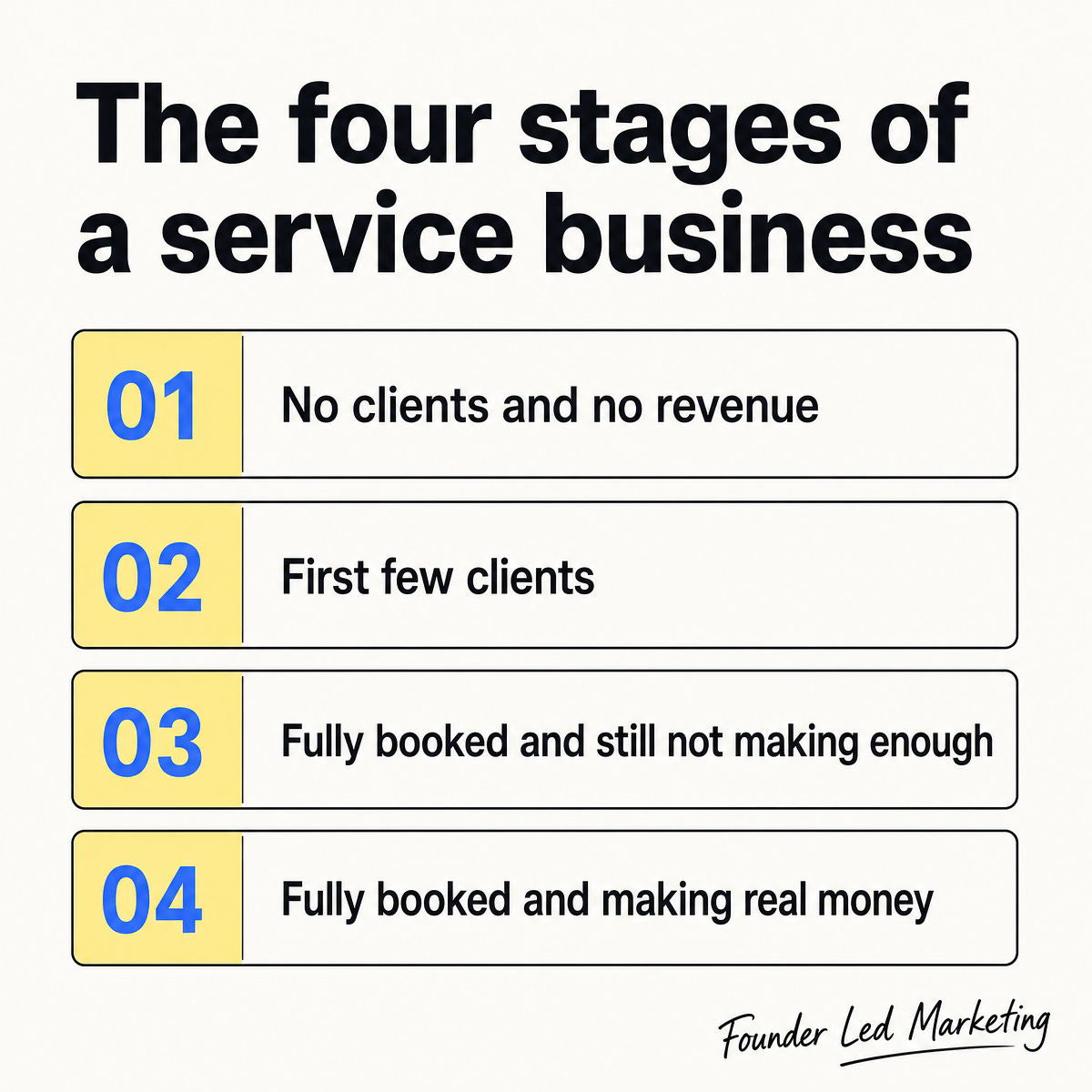
These aren’t necessarily consecutive.
The same activity can be the right move in one stage and a waste of a month in another.
A friend of mine went to a workshop on AI and automation for small businesses last month. She told me three workflows they talked about: use templates to build landing pages, build a bot that listens to your sales calls and gives you feedback, set up an email sequence.
Twenty different businesses in the room, one set of instructions.
None of that is bad advice on its own. The problem is it sends you off building things that won’t change your numbers.
The idea I keep coming back to
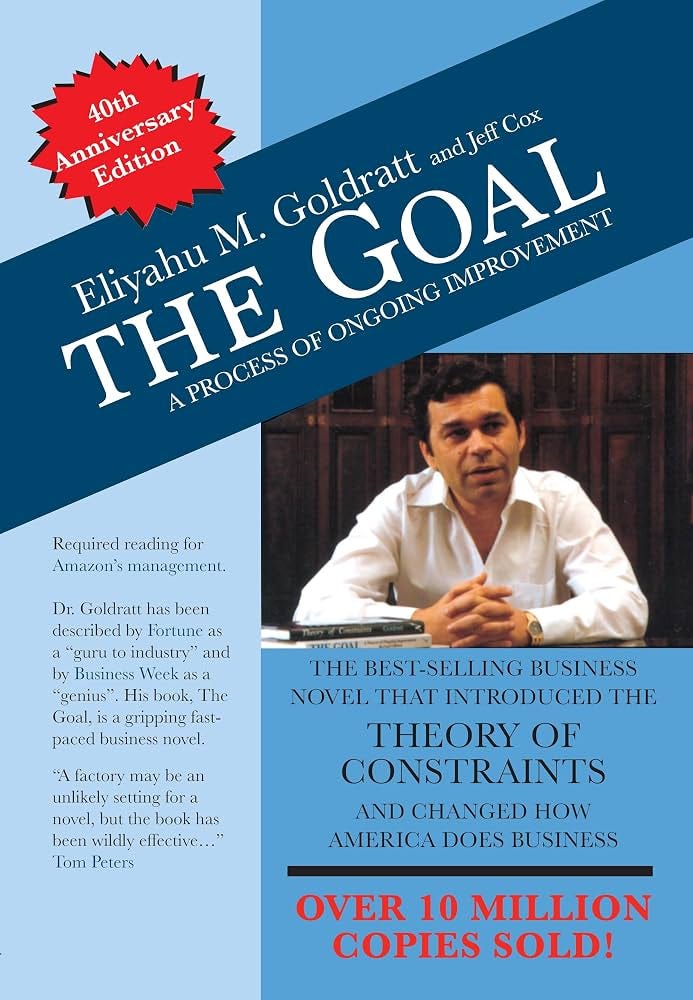
Eliyahu Goldratt wrote a book in 1984 called The Goal. It’s about a factory, and the argument is simple enough to explain in a sentence: at any moment one thing limits your output, and work you do anywhere else in the system produces nothing.
You find the constraint. You get everything you can out of it. You subordinate the rest of the business to it. Then you break it, and the constraint moves somewhere else.
When you solve your constraint, you don’t get to keep working the same way. You’ve now got a different limit, and the activities that were correct last quarter become the activities that waste this one.
I use the same approach with founders working alone.
So here are the four stages I ask about, and what’s actually limiting each one.
Stage one: no clients, no revenue
You’re starting out. Nobody has paid you yet.
For solo-founders, the constraint here is cash and time on the clock. You’re living off runway, and every week costs you something real.
Everything subordinates to sales. Build a first version of the offer, go talk to people, do outreach, get some momentum. You won’t have a good answer for who you serve or what makes you different, and you shouldn’t wait for one. Take what you know so far, turn it into a temporary position, and run with it. You fix it later with information you can only get from selling.
Marketing at this stage does one job. Someone you message will look you up, so there needs to be something there. That’s it.
The mistake I see most is a founder at stage one spending three weeks on a website. That’s work for a constraint they don’t have yet.
Action items:
Build a first, temporary version of the offer.
Do outreach and go talk to people until you get paid clients. Examples: a short workshop or a small, direct offer sequence (no heavy automation required).
Publish a minimal thing people can look up.
Measure: count paid customers and momentum from outreach. Has anyone paid you yet and are inquiries increasing?
Stage two: a few clients, something starting
Here the constraint changes to proof.
You have a little revenue, and you still think short term because a few clients can disappear fast. But the thing limiting you now is that nobody has evidence your service works, including you. You don’t actually know yet whether what you sold does what you said.
So delivery comes first. Do the best work you can, and take notes while you do it. What the client came in with, what you changed, what happened. Those notes are your marketing for the next two years.
Keep selling. Just don’t let the selling cost you the proof, because the proof is what’s blocking everything downstream of it.
Action items:
Deliver the best work you can.
Take notes on client situation, what you changed, and outcomes.
Turn those notes into case material and keep selling.
Measure: documented client outcomes, notes, and case material that show the service works.
Stage three: fully booked, not making enough
The constraint is your hours, and this is the stage that feels the worst.
Your calendar is full. Your bank account isn’t. There’s no time to sell and no time to market, and no obvious way out because the only lever you have is already pulled all the way down.
Goldratt would tell you to stop trying to work harder inside the constraint and start elevating it. Two ways to do that.
You can run with it and build reputation until it lets you raise prices. This works, and it takes longer than you want, because what makes a higher price possible is people believing the service works.
Or you change the pricing and the shape of the offer now. Package it differently, sell to a different level of buyer, cut the parts that eat hours and add nothing.
Either way you’re thinking mid term, and this is where marketing stops being optional. Reputation is what lets you charge more, and marketing is how reputation gets built when you’re not in the room. If you’re fully booked and quiet, you rebuild your pipeline from scratch every time a client ends.
Action items:
Stop trying to work harder inside the hours constraint.
Either build reputation so you can raise prices, or change pricing/offer shape now (repackage, sell to a different buyer, cut time-eating parts).
Make marketing part of rebuilding the pipeline.
Measure: hours versus income. Is your calendar full while the month’s earnings still feel uncomfortable?
Stage four: fully booked and making real money
Here the constraint is you.
Every next thing depends on getting delivery off your own hands, which makes hiring the main question.
This is also the first stage where expensive marketing makes sense. A podcast, a research report, a real newsletter, sponsorships, a proper site. Those pay off over a year or more, and you need to be able to survive the year.
A podcast at stage one is a way to feel productive while avoiding outreach. At stage four it’s a reasonable use of money and time. Same activity, completely different decision, because the constraint is different.
Action items:
Move delivery off your desk by hiring.
Invest in longer-term, higher-cost marketing (podcast, research report, newsletter, sponsorships, proper site).
Measure: your ability to remove yourself from delivery and sustain longer-term marketing investments (hiring progress and whether you can survive the year while those channels mature).
What stays the same
Something goes out regularly at every stage. Consistency isn’t stage dependent.
I’ve written about this in my “Base and Bursts” article.
Quick reminder. Base is the content you put out on a regular schedule. Bursts are the extra marketing pushes you make during the week.
At stage one, strapped for time, your Base can be very thin.
If you are at stage one, and strapped for time, you can have a really thin Base.
The Base and Bursts change every time. At stage one it supports outreach. At stage two it turns into case study creation. At stage three it builds the reputation that makes a higher price believable. At stage four it builds a position competitors can’t copy quickly.
Two examples of stage one in practice.
Face yoga instructor example
A face yoga teacher came to me with no clients. We built a five meeting workshop and then the offer that came after it. No landing page, no automation. The work was deciding what she was selling and in what order.
She went from zero to eight people booked.
Dev company example
I helped the founder of a dev company define his first small offer, then launch it, then run outreach for it. The answer was the offer and the sequence.
Both were stage one, so both were constrained by sales. Neither one got solved by a tool or an automation hack.
Which leaves two things I recommend to anyone building something new.
The first is being able to see your whole business as one system. The hours you have, the places you could put them, and which of those places would move your numbers. Most founders only see the area they’re already working in, which is why the fully booked ones keep taking on more clients and the empty ones keep redesigning their website. I wrote about this here.
The second is execution, and this is the part that takes experience. Knowing how to run something as an experiment, with a hypothesis you can be wrong about, so that a month of work either teaches you something or gets cut.
How to diagnose which stage you’re at
Has anyone paid you yet? If the answer is no, you’re at stage one, no matter how long you’ve been at this or how good the thing is.
If yes, then: is your calendar full?
Not full means stage two. You have clients, you have room, and what you don’t have yet is evidence.Calendar full means you’re at three or four, and the split is money.
If your calendar is full and the number at the end of the month still makes you uncomfortable, that’s stage three.
If it doesn’t, that’s stage four.
Most people I talk to already know the answer and are hoping for a different one. If you’re fully booked and broke, you’re at stage three even if you’ve been doing this for six years.
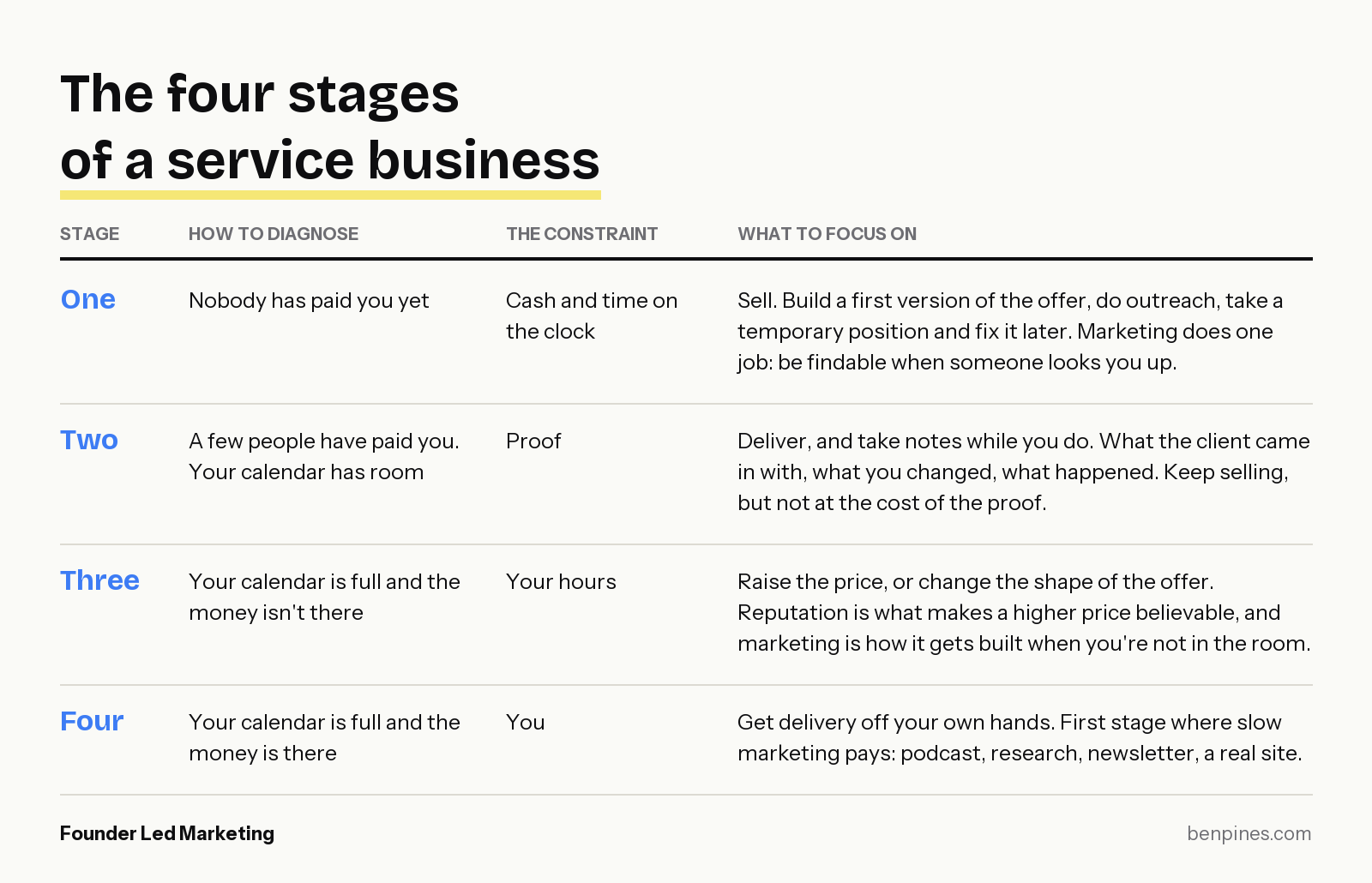
Here a visual to summarize the action plan:
If you’re building something right now and you’re stuck on marketing, the right question is what you’d have to be right about for the next ninety days to count for anything.