

I’ve seen people at every level of seniority post consistently for a month yet stay at close to zero impressions.
I’ve yet to find the LinkedIn expert to address this properly, so I decided to create this guide myself.
There’s plenty written about reach dropping on LinkedIn, but this is a different problem altogether. But how does that help you, this week?
Jasmin Alić, for example, wrote a post about low reach, and his answer was basically just to ignore and keep posting.
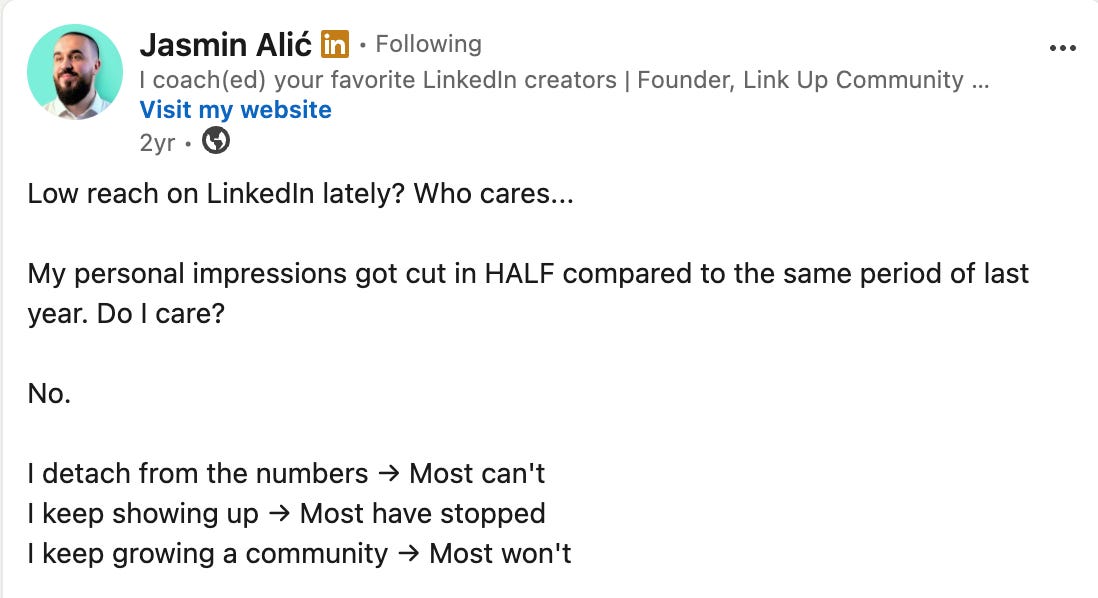
Ignoring and posting is not really a solution for a solopreneur who needs to start seeing results to justify the time spent on LinkedIn.
Matt Barker wrote his own perspective, where he said he is changing his hook, his visuals, pretty much everything. I don’t think this is a sustainable approach, especially for busy solopreneurs.
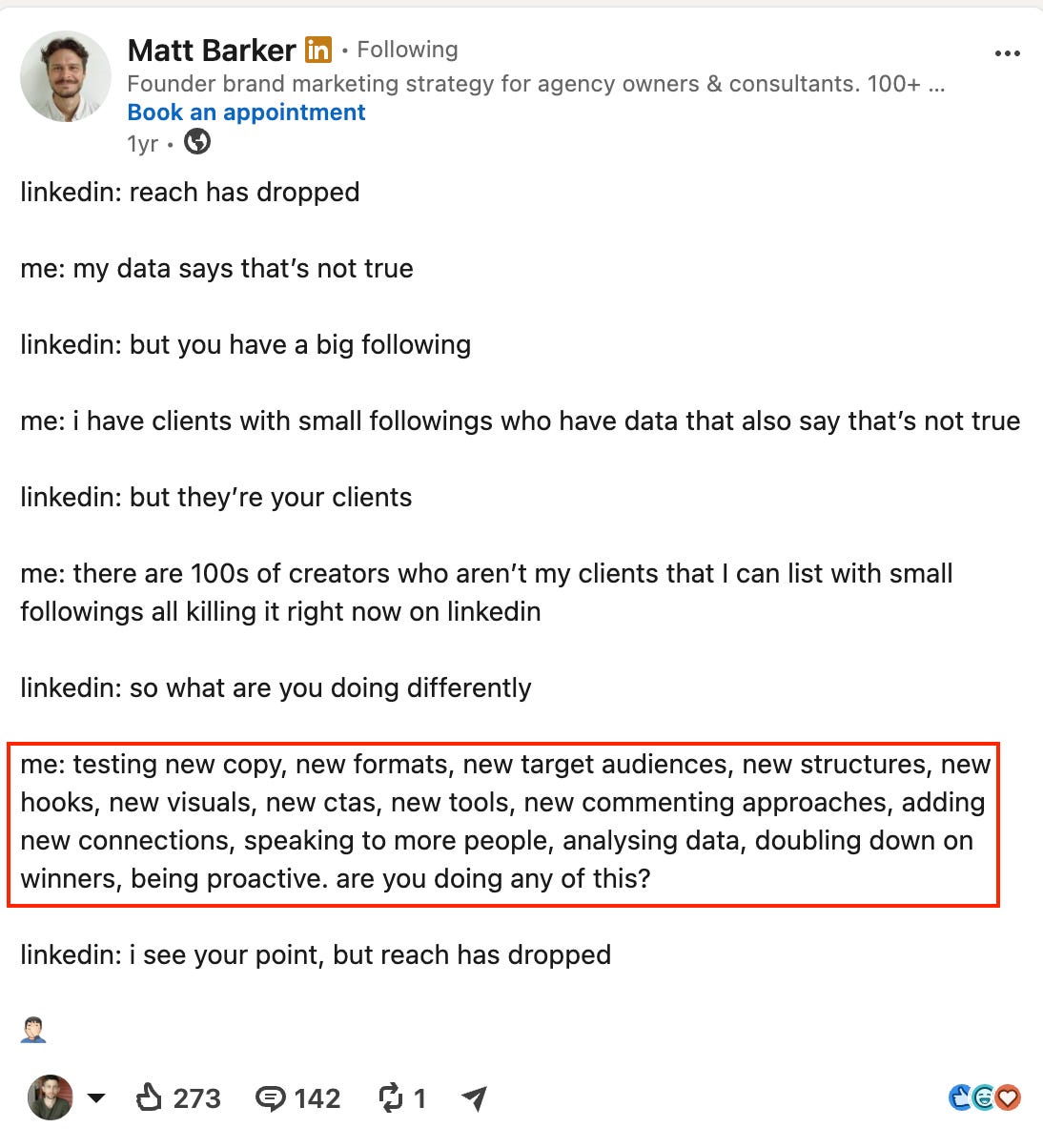
That’s also not really helpful, because no founder has the time for such experimentation.
The problem is that both these LinkedIn figures, even if they suffer 50% drops, they can still maintain their business. But if you’re part of the 99.99% of the rest of us regular posters, this advice doesn’t apply to you.
You’re trying to start from a flat line, and need to start seeing activity or you’ll switch to another platform.
I’ve walked several clients through this. For this post, I’ve reverse engineered what I actually did, and I organized it all in a sequential workflow. Here it is.
First diagnose what is your LinkedIn reach issue.
The instinct at week four of getting no reach is to change everything at once. New hooks, new format, new topic, maybe a video.
That rarely works. It also kills the learning because you keep resetting what you are doing, and the LinkedIn algo doesn’t get what topic you are trying to target.
Instead, work through these eight questions.
1. Are you under a penalty or are you being ignored?
This test I’m suggesting is not science, and is not a verified method, but I use it.
If you’re used to getting 1,000+ impressions per post, and all of a sudden you get 80, it might be a penalty.
In contrast, getting between 200-300 impressions is most likely not a penalty. This is the LinkedIn algorithm showing your post to a small initial crowd, and deciding not to spread it further.
There are several main reasons LinkedIn may have dropped your reach:
You didn’t stay consistent to a main topic of interest you already won.
You ran an automation of some sort, or scraping LinkedIn.
You use engagement pods, those could also hurt your reach.
Or, of course, maybe the post you wrote simply wasn’t good enough.
If you think it’s a penalty, stop everything you’re doing outside the feed. Turn off the automation, leave the pod, and post normally for two or three weeks. If the numbers come back, it indeed was a penalty.
2. Do you have one topic you keep returning to?
Scroll your last 20 posts and try to write your topic in one sentence.
Do you have a main topic?
Some people only write about one topic: AI, SEO, UX… These people are usually the ones who get the most reach, because the LinkedIn algo knows how to show their posts to the right people with the right interest.
This matters more than it used to, because LinkedIn replaced its old ranking pipeline with a single large model (they call it 360Brew) that actually reads text and matches it semantically.
It needs to know what you’re about before it can decide who to show you to.
Devin Reed changed his own profile in public last year, following 260Brew.
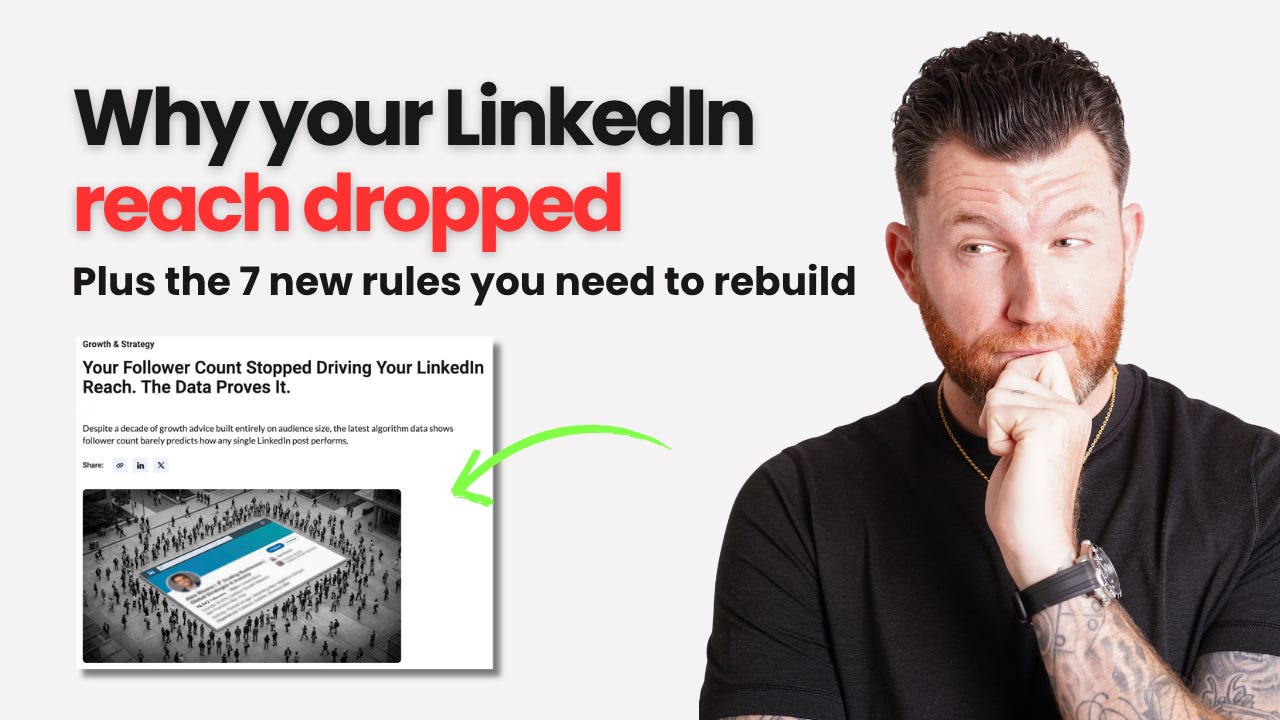
He tore down a 100k-follower account and rebuilt it around fewer topics, and wrote up the whole thing. His conclusion was that he’d attracted the wrong audience. Worth reading if you want to see someone do it at scale.
3. Does anyone already care about this topic apart from you?
You can do everything right, but if your topic is around a boring topic, you’ll still not get reach.
The model can only route your post to people whose interests match it. If nobody is already interested in the thing, there’s nowhere to route it.
So check. Search the topic. Is anyone posting about it, and is anyone commenting? You can use AI to run these queries, or test a platform like Sparktoro and try to see where the audience of this topic consumes their content.
Example
For example, I write a lot about when NOT to use AI for writing.
There’s someone who write about this even more consistently than me, Mike Rosenberg.
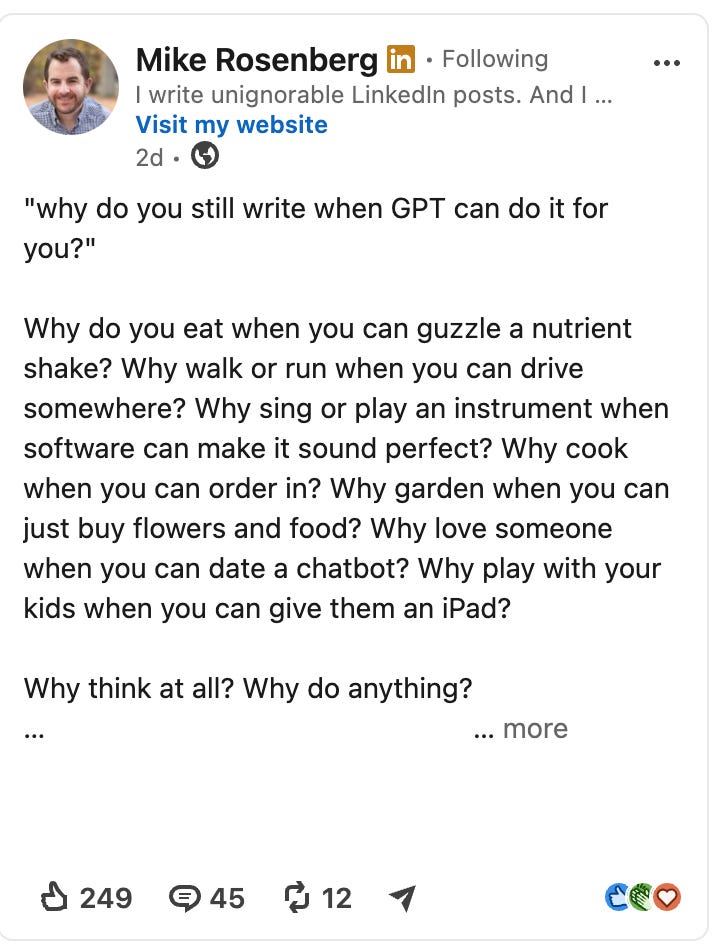
Knowing there’s a successful LinkedIn figure out there who write about this gives me confidence about focusing on this topic myself.
I can also follow his posts to get inspiration about what to write next and which posts resonate.
4. Who is this for, specifically enough that you could name five of them?
When I pose this question to prospects or clients, I sometimes get vague answers like “B2B founders” or “marketing people”.
Name five real people who should read this post. You can even do the next steps of directly talking to them and asking what they would find interesting to read.
Example
When I started posting on LinkedIn last year, I made a list of 20 SaaS solopreneur founders from my area, and made sure to follow each of them. This way, I got to know how frequently they posted, and recognized some mistakes each of them made.
This way, I knew I was writing for specific individuals, not just generic founders.
5. Are you contrarian enough?
Most flat posts are accurate and boring.
If no one will contradict what you are saying, it probably means it’s not contrarian enough.
Nowadays, you need to state claims that are bold enough to signal to the world that you have a unique perspective to say.
Example
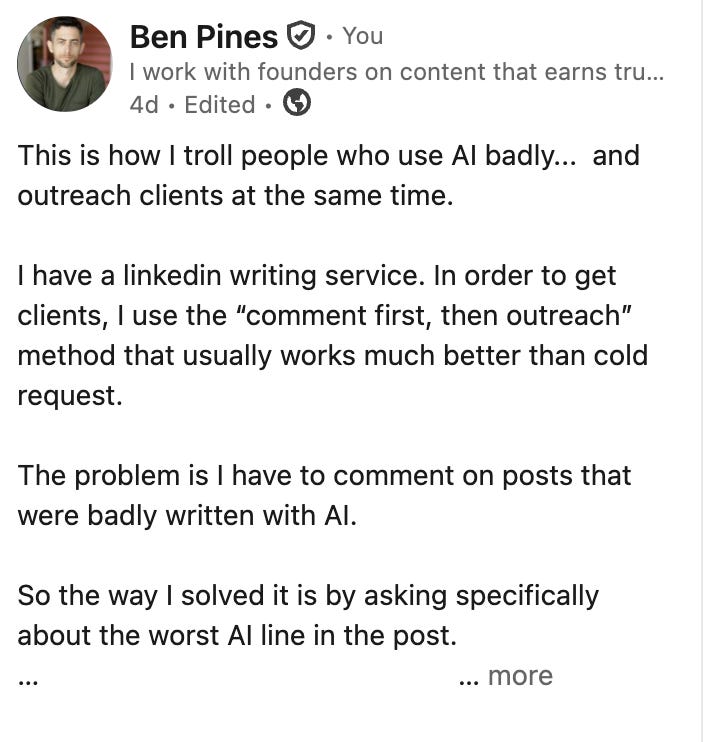
In this post I share a contrarian and perhaps outspoken post that details how I troll people who use AI badly by commenting on their post regarding the part that was written with AI.
6. Are you doing anything on this platform other than posting?
A month of publishing into a feed where you never comment, never DM, never show up anywhere else is a month of shouting into a room you haven’t walked into.
This is also the fastest thing that works when you have no audience. Posting is the slowest possible way to get your first hundred readers. Commenting in front of someone else’s audience, and messaging people already connected to you, is where the first calls actually come from.
When we launched BeSeenByAI, the post that did the most impressions wasn’t what got us demos. Direct messages to warm connections were.
7. What are you actually measuring, and is it the thing you really need to measure?
A month of no likes feels like failure. But likes were never the goal.
There’s a good writeup on ContentIn comparing a post with 93,000 impressions to one with 838, where the smaller one performed better on everything that mattered.
I actually shared a similar result myself:
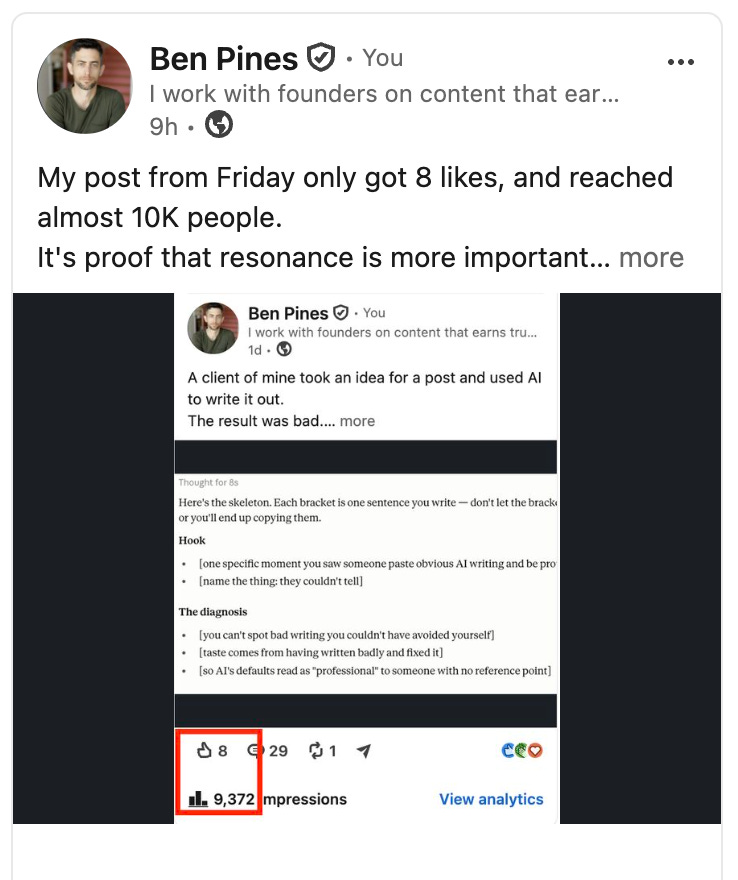
Write down what would count as this working, before you look at analytics again. If the honest answer is “more impressions,” you’ve picked a number that can go up while your business stays exactly where it is.
8. Would you read this if someone else posted it?
Read your last twelve posts as if you were a stranger. Answer honestly whether you would stop scrolling and actually read it.
My experience has shown that if you let go of the need to write for results, and start writing posts you would actually enjoy reading, it actually gives you motivation and also produces the best posts.
Plan of action - fixing your reach
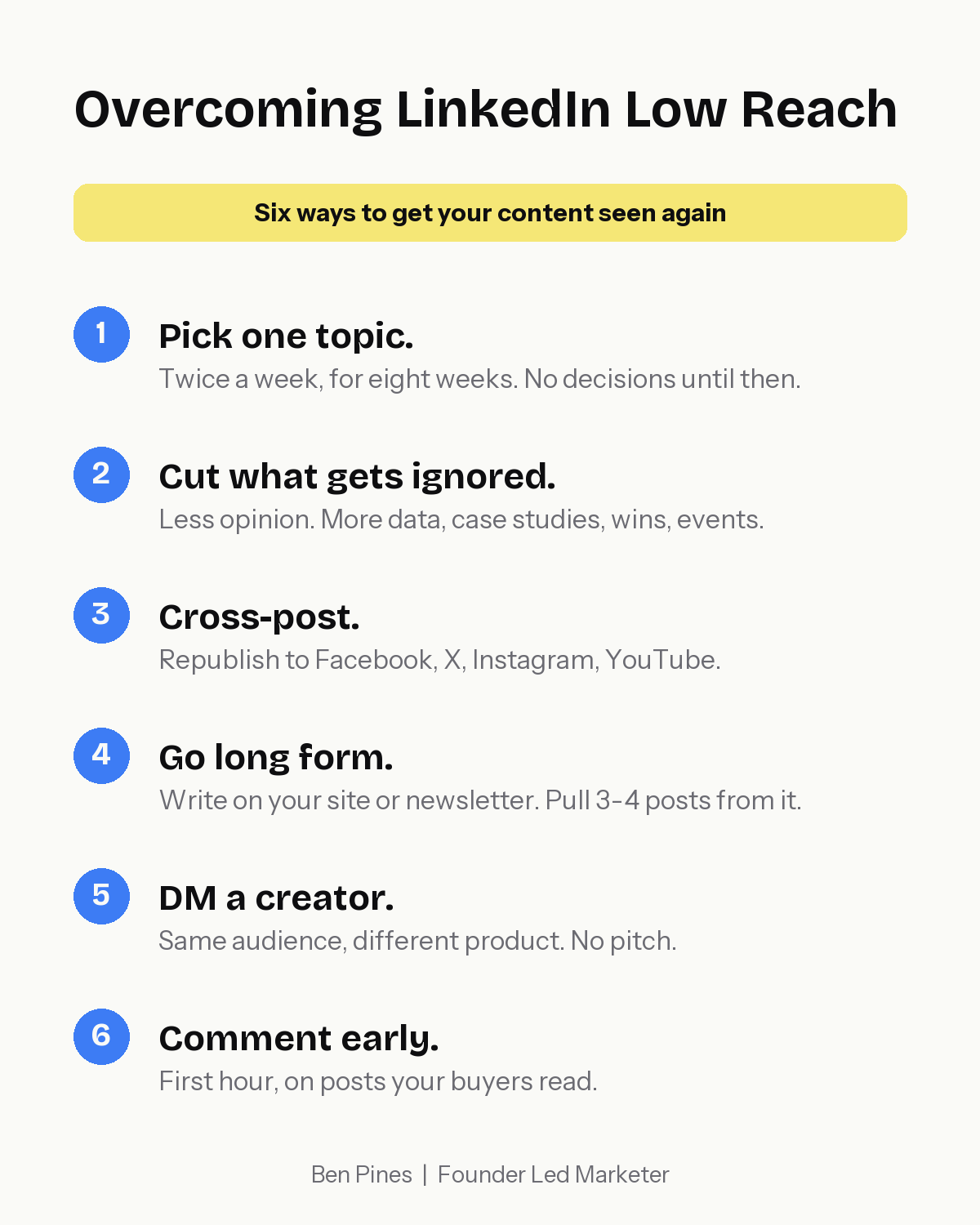
Now that we covered how to diagnose the issue, let’s move to fixing it. I don’t recommend running all these actions. Rather, once you diagnose your issues, and know the pros and cons of each suggested action, you can prioritize them and choose which ones to run first.
1. Pick one topic.
This is the most recommended action of them all.
Pick your topic and say this out loud:
I’m writing about [topic] twice a week for eight weeks, and deciding nothing until then.
The platform needs a consistent signal before it can place you, and you need enough posts to see which ones landed.
2. Reduce posts that are easily ignored and increase posts that are not.
This action takes some expertise and knowledge. If you consistently publish opinion posts, this may be the issue.
For the next two months, reduce formats like these that have no “skin in the game”, and increase posts that are more unique. A good way to know if a format is unique is to ask: “could AI have made it?”.
AI can write an opinion post. It cannot write a research and data based post. It cannot write a case study.
So, for the next two months, experiment with any of these formats, while maintaining the topic you chose before:
Newsjacking posts
Stats and data
Case studies
Achievements
Publish about events you attend
3. Publish in another platform
I had a client take his existing LinkedIn material and start cross-posting it to Facebook as well.
The same post that got almost no response on LinkedIn got dozens of likes and thousands of impressions on Facebook.
You can repurpose that same posts to any number of platforms, including:
Facebook
X
Instagram
YouTube
This action takes you almost no extra effort and lets you know if the problem is specifically with your writing or with the LinkedIn algo.
4. Experiment with long form
I’m convinced there’s a unique power in long form that still delivers. This entire guide, for instance, only exists because I committed the hours required to reverse engineer the workflow into a deep-dive format.
Long form works because there’s skin in the game. Almost nobody will sit down and reverse engineer their own process for a few hours, so the ones who do stand out by default. You don’t need to publish it on LinkedIn either. Put it on your site or your newsletter, then pull three or four posts out of it for the feed.
5. DM a creator with a similar audience
Everything becomes easier when you start engaging with people, especially the people you write for.
Pick people who write for your buyer but don’t sell what you sell. Read a few of their posts first, then send something specific about one of them and what you’re working on. Don’t pitch anything. Most of these go nowhere, and the ones that land turn into comments on each other’s posts, which is exposure to an audience you’d otherwise have to build from scratch.
6. Comment on other people’s posts
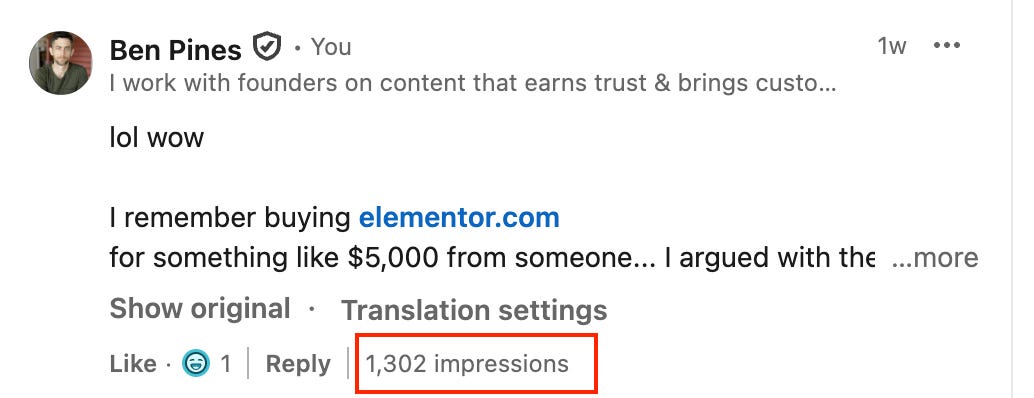
Some people don’t comment at all, and that’s OK. But if you are getting no reach, commenting can give you a boost.
I sometimes get more impressions on comments than on regular posts (like above).
Most of the individuals who are successful on LinkedIn comment regularely.
Comment on posts from people whose audience you want, not on posts from your friends. Aim for the first hour, because that’s when the post is still being shown around and your comment travels with it.
Write something that could stand on its own as a short post. “Great insight” gets you nothing. Disagreeing politely, or adding the part the author left out, gets you profile visits.
Still no traction
It might be the case that you’re not seeing something that’s missing from your content, and that’s hard to spot from the inside.
It’s what got me through this myself. I kept searching for what I actually wanted to write, wrote it, and kept trying new ways of expressing it that fit the algorithm more closely, until the two lined up. That took me longer than it needed to, because I was reading my own posts.
So if you’d rather not guess at which part is holding you back, send me your last posts and I’ll tell you which of the eight questions you’re failing. benpines.com, or just DM me on LinkedIn.