


You’ve probably convinced yourself the game is rigged.
You watch a post far less sophisticated than yours pull thousands of likes and hundreds of comments, and you conclude that these people already have an audience, so every sneeze they post gets attention. “I don’t stand a chance. Why bother?”
You also say “PLEASE, not another claude agent post!”
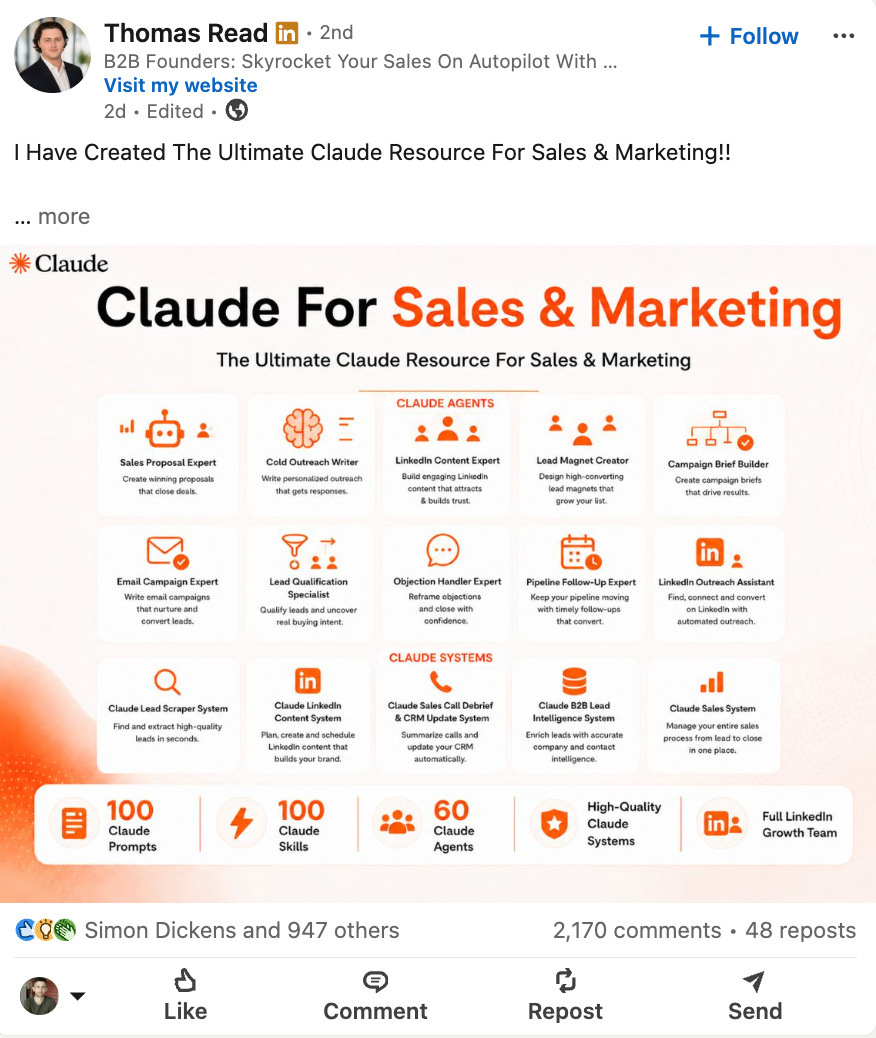
I’m here to tell you there is a chance to win LinkedIn, and you should bother.
What looks like a random post going viral almost always has a winning strategy working in the background. A decision made long before the post was written, about who the content is for and what it’s supposed to do.
The formula for this is what I want to share with you guys today. (I know “formula” may set off your bullcrap alarm, but nevertheless I do hope you stay with me here).
How to win attention
The challenge of winning attention isn’t new. In 1981, Al Ries and Jack Trout published Positioning: The Battle for Your Mind, where they described an overcommunicated society.
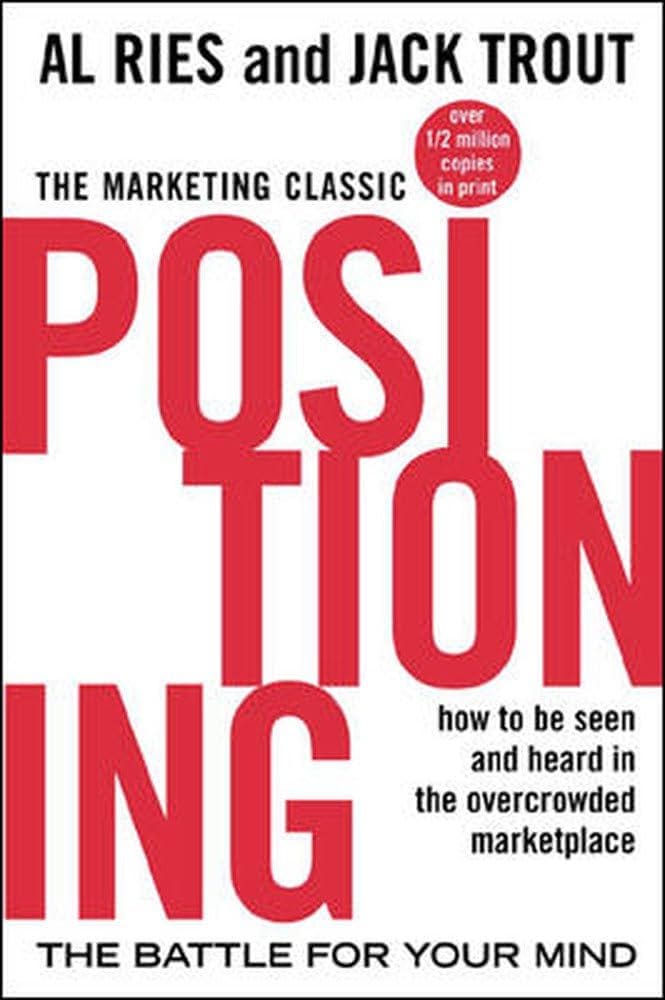
Yes, in 1981. Too many companies, too much noise. That was the diagnosis four decades before the feed, before the algorithm, before an AI could write a passable LinkedIn post in seconds.
So consider where that leaves us now.
Three years ago, a founder could get away with being a slightly generic domain expert, or posting the occasional recycled insight, or vaguely building in public. It worked well enough.
Today those same moves are invisible. AI can produce content at infinite scale and zero cost. If Ries and Trout thought the room was crowded in 1981, imagine it now. Every message has an infinite number of near-identical twins, generated in seconds, and published across all socials.
I’ve hit this wall with nearly every founder I work with. The fix is almost always the same, and it’s smaller than they expect: they’re approaching their audience the wrong way.
There are three strategies that work, and you have to pick one. That choice is what makes or breaks you on a platform like LinkedIn.
Where do we start? Questions to nail before ever starting to publish
When a founder hires me to build their LinkedIn presence, I start by asking two foundational questions:
Who is your ICP?
Who is your broader audience?
Sometimes, these are the same groups of people. If so, the work is much easier. Your content can speak to your ICP directly, and the rest of this article matters less for you.
If you are a dating coach, your ICP may be men in their 30s looking for a date.
Your broader audience will be the same. Having an exercise to help your ICP start communicating with women in bars will also help your broader audience on social media.
More often than not, however, especially for niche technical products, you won’t be able to generate interest behind your product or service.
If, for example, you’re promoting an employee time tracking tool, you won’t be able to attract attention by sharing “10 ways to track your employees’ time effectively”.
That may have worked in 2018, but nowadays it doesn’t.
In that case, you choose a different method. You go for a broader audience, sometimes your peers, and you use a completely different strategy.
Writing content for the broader audience
The next set of questions have to do with figuring out the purpose of your content.
I ask:
How does this content serve you? (Your service, product, leadership, management, thinking, strategy…)
How does this content serve your ICP? (Their specific problem)
How does this content serve your broader audience? (And what value does it provide them?)
A word on why I emphasize serving. It seems like everyone on LinkedIn is talking about “winning hooks”, gaming algorithms, link farms, engagement bots. But if branding is a game of trust, gaming contradicts the whole premise.
The shortcut backfires. So I insist on a different starting point: ask how your content serves everyone involved, including yourself.
That forces your brain to create real value instead of chasing metrics.
The hardest (and most important) question is the third one:
How does this content serve your broader audience?
This question is not multiple choice. You pick one of three approaches:
Domain Expert — You’re the authority in your specific field. Your content serves your broader audience by being the definitive resource.
Topic Expert — You’re the person to quote on one specific insight. Your content serves your broader audience by being shareable and applicable everywhere.
Build in Public — People follow you, not just your conclusions. Your content serves your broader audience by showing the real path, not the polished result.
Once you choose one lane, everything else becomes obvious. The formats you use, the cadence, how you handle comments, your entire content calendar.
Domain Expert Strategy
When you choose to become a domain expert, you pick a certain popular domain, like SEO, or ad creatives, and try to become the authority for that content.
If you are able to, I recommend you choose this strategy.
Why? Because then the user journey is the shortest. They see your content, and it talks about a topic very close to your actual service. The leap from reading your content to becoming your client is the shortest.
Some examples of domain experts you might know:
Lenny Rachitsky (product management)
April Dunford (positioning)
Here is Dunford talking about positioning and AI:

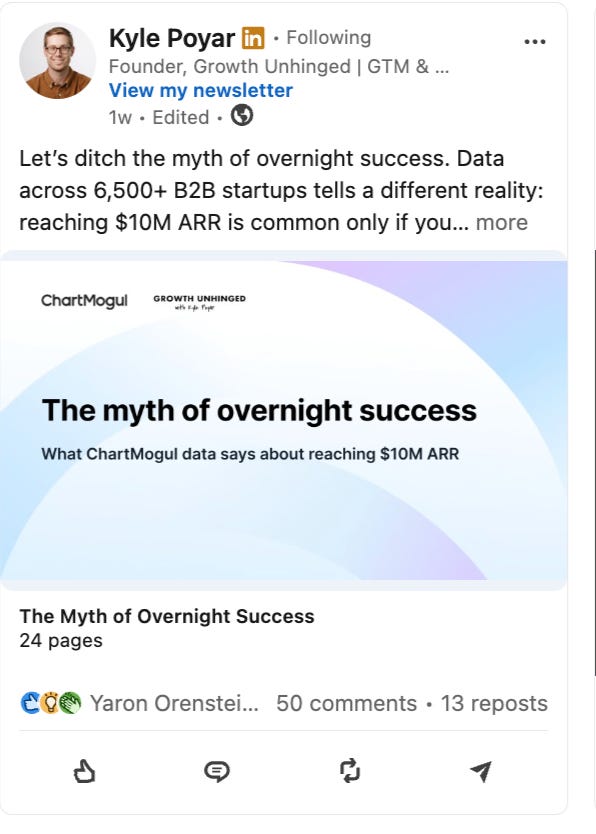
Kyle Poyar (growth)
Here is Poyar talking about growth:
Ali Abdaal (productivity)
Esther Perel (relationships)
In all these cases, these experts are masters of their industry. They manage to reign over a bor field, and that makes the job of staying in their lane while getting enough attention the easiest.
Topic Expert Strategy
Sometimes you end up thinking that domain expertise is not the right lane for you. Maybe it is too competitive (like Vincent Pierri for GTM, he pivoted to infographics expert), maybe it is too boring or too general (cybersecurity compliance, say).
In these cases you go for a certain topic.
Examples:
Tiago Forte (Knowledge Management)\
Anthony Pierri (Homepage positioning)
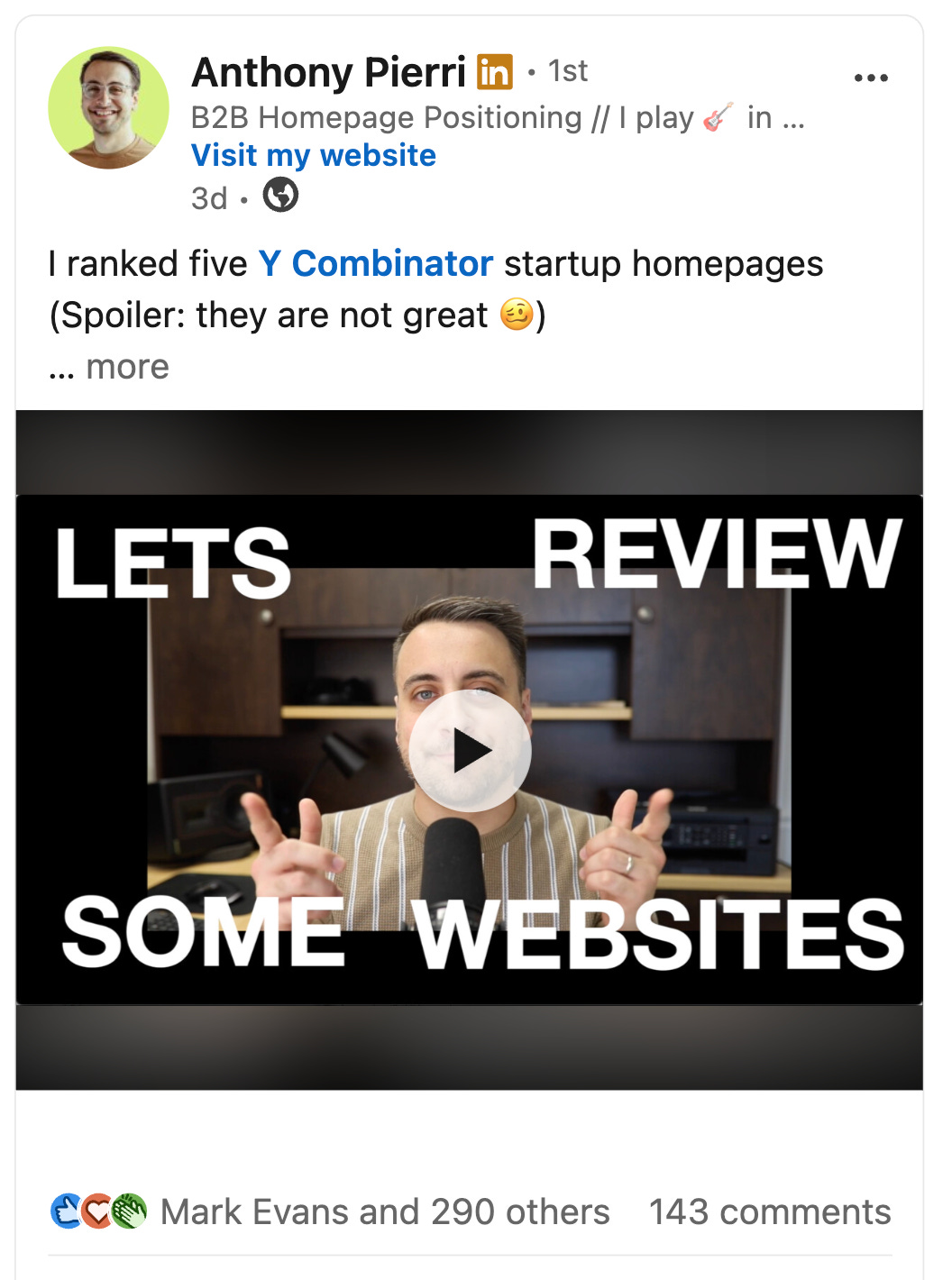
When you choose to dominate a certain topic, you most likely won’t publish content solely on that topic. You do, however, need to make sure your mix has enough content on topic to keep you as the known expert in that field.
Build in Public Strategy
To succeed in Build in Public you have to be all in. That means the journey is the content. Revenue numbers, failed launches, the decision you got wrong last month. Instead of posting now and then occasional behind-the-scenes posts between expertise threads, you continuously share your journey and this way give incentive to your audience to also continuously follow you.
Your audience’s gain from your Build In Public content is derived gradually, as you continue to share different attempts you make to succeed.
Examples:
Marie Martens (I covered her strategy last week)
If you recall, Martens is the founder of Tally, which is a form builder. If she had talked about forms on LinkedIn every day, people wouldn’t give her the time of day.
Instead, she focused on 7 formats that all were related to a Build in Public strategy, and it worked.
Give your business an assessment
If there is one message in this article, it’s that the game of LinkedIn is much more about analyzing your industry and the interest around it BEFORE starting to publish.
You see content creators on LinkedIn share advice on how to win LinkedIn (yes I do that too…) and you should question whether their strategy works because the audience in LinkedIn is most geared to get advice on LinkedIn success.
What works for their LinkedIn marketing service might not work for your time tracking business. People just won’t care enough.
If you reach this conclusion, know that there are many founders who manage to get leads and sales by:
Addressing a larger audience.
Not focusing on their product / service, and instead sharing their journey.
Final note, if you find all this confusing and want to see how this relates to your business, feel free to reach out to me or comment below.