

Like most things in marketing, audience research is often over-complicated.
Founders frequently fall into analysis paralysis, waiting for a perfect persona before shipping.
In this article, I will share my workflow for identifying a client’s target audience and how to plan the content that will get their attention.
Since I help founders build their presence on LinkedIn, I rely on a systematic approach to ensure consistent results across different industries.
Why is audience research confusing?
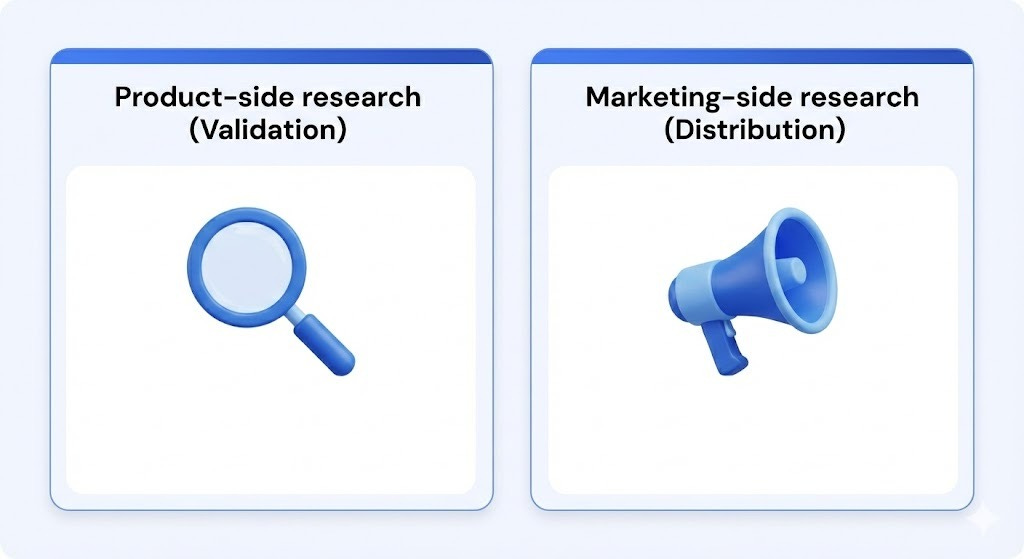
One reason stems from a failure to distinguish between two distinct organizational needs:
Product-Side Research (Validation): What problem are we trying to solve?
Marketing-Side Research (Distribution): Where do these people hang out, and what triggers their attention?
Even with a focus on distribution, static research only takes you so far. You must accept that you are starting with assumptions. True knowledge of your audience and their preferences only accumulates over time through execution.
This process of iteration, adapted from Eric Ries’ The Lean Startup, is known as a continuous feedback loop. I am applying this same concept to marketing: you cannot truly know your audience until you publish content and measure the signal vs. noise.
By publishing consistently and analyzing the response, you discover which formats, topics, and styles resonate most.
What point are we trying to reach?
With our simplified process of audience research, we are only trying to answer four fundamental questions. We are not interested in which of the 12 archetypal personality types they are, nor how they align with the “Big Five” traits.
The reason for these specific questions is that these are the questions we need to get business. If a piece of data doesn’t help you answer one of these, it is a distraction.
The questions are:
1. Who is the target audience?
This is about functional identity. In a B2B context, this usually means their job title, the size of their company, and the specific software they use.
2. What would get their attention?
This is the awareness stage. You need to identify what information they find helpful and interesting.
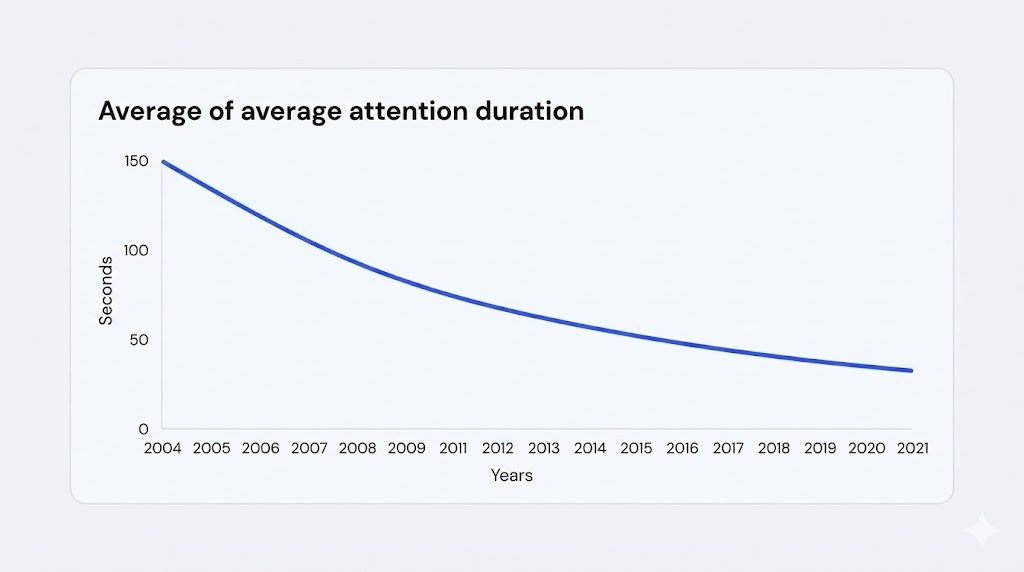
According to Gloria Mark, professor emerita of informatics at UC Irvine, the average screen attention span dropped from two and a half minutes in 2003 to just 47 seconds in 2020. Even more aggressive is the “3-second hook” reality: on platforms like LinkedIn and TikTok, users often decide whether to stay or scroll in under 6.5 seconds.
According to the Information Foraging Theory, users are hunting for high-yield information. If your content provides a high reward for low effort, they will stop.
3. What would get them to submit their contact details?
This is the bridge to an owned audience. You need to identify the minimum viable value you can provide in exchange for an email address.
For a developer-tool founder, this might be a cheat sheet for a specific framework. For a coach, it might be a 5-minute audit template.
4. What would get them to buy from us?
This is the most critical question. If you crack every other stage of the funnel but fail here, your business cannot sustain itself. You won’t be able to buy groceries or pay rent.
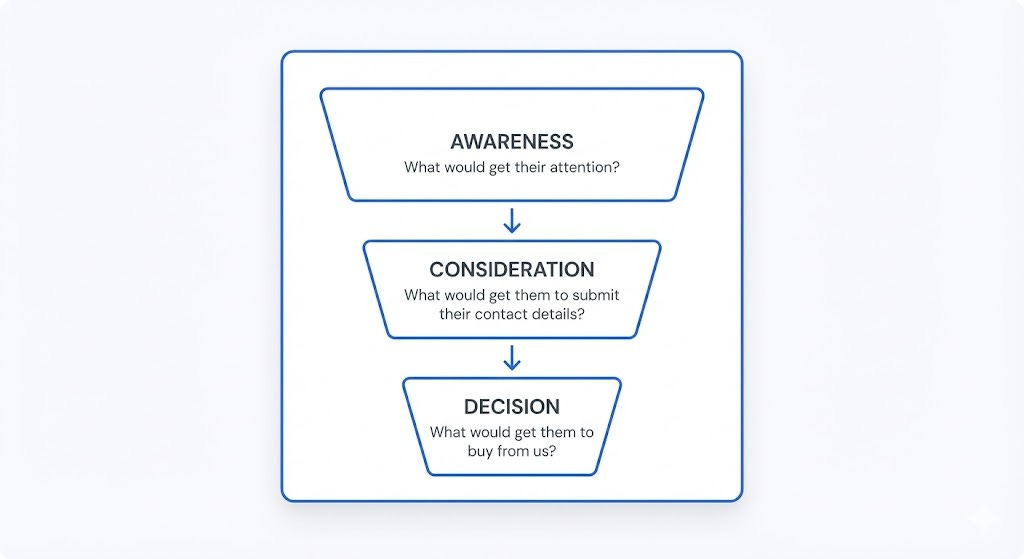
You might have noticed that this list of questions correlates to the good ol’ marketing funnel.
While some say the marketing funnel is dead, it remains the most efficient way to categorize research. Your research must solve for the three stages of awareness (question 2), consideration (question 3) and decision (question 4).
The process begins!
This isn’t another “general advice” article. To show you how this works in practice, I will break down exactly how audience research shifts during each stage of my process when I build a LinkedIn content plan with my clients:
Step 1: Audience assessment – Doing basic research and identifying some basic things about the target audience.
Step 2: Making assumptions – Creating assumptions about the audience.
Step 3: Execution – Testing assumptions through live content.
Step 4: Measurement & course correction – Turning engagement data into a refined audience profile.
Step 1: Audience assessment
At this stage, the goal is to establish the foundational pillars of your audience:
Identity: Defining the specific target audience group, including their roles and psychographics.
Context: Identifying where they hang out online (e.g., LinkedIn for B2B, Discord for developers, or Instagram for lifestyle).
Influence: Finding the thought leaders and voices that already have your audience’s attention.
Competitors: Who are your competitors and what are they doing to draw their audience in?
When I sit with clients, I often have to push them to choose a single target audience.
While a product usually serves multiple groups, you must pick one for your first marketing cycle. You are testing a hypothesis, and you need to isolate variables to ensure the experiment is clean.
Real-world examples of niche focus
The Service Business (Face Yoga): One client had helped thousands of people, but through systematic questioning, we identified her most profitable segment: HR Directors in Tech. They have high stress, significant disposable income, and a professional need to maintain a composed appearance.
Context & Influence: We identified Instagram as their primary platform for wellness content and found they already followed several high-profile Face Yoga influencers for daily routines.
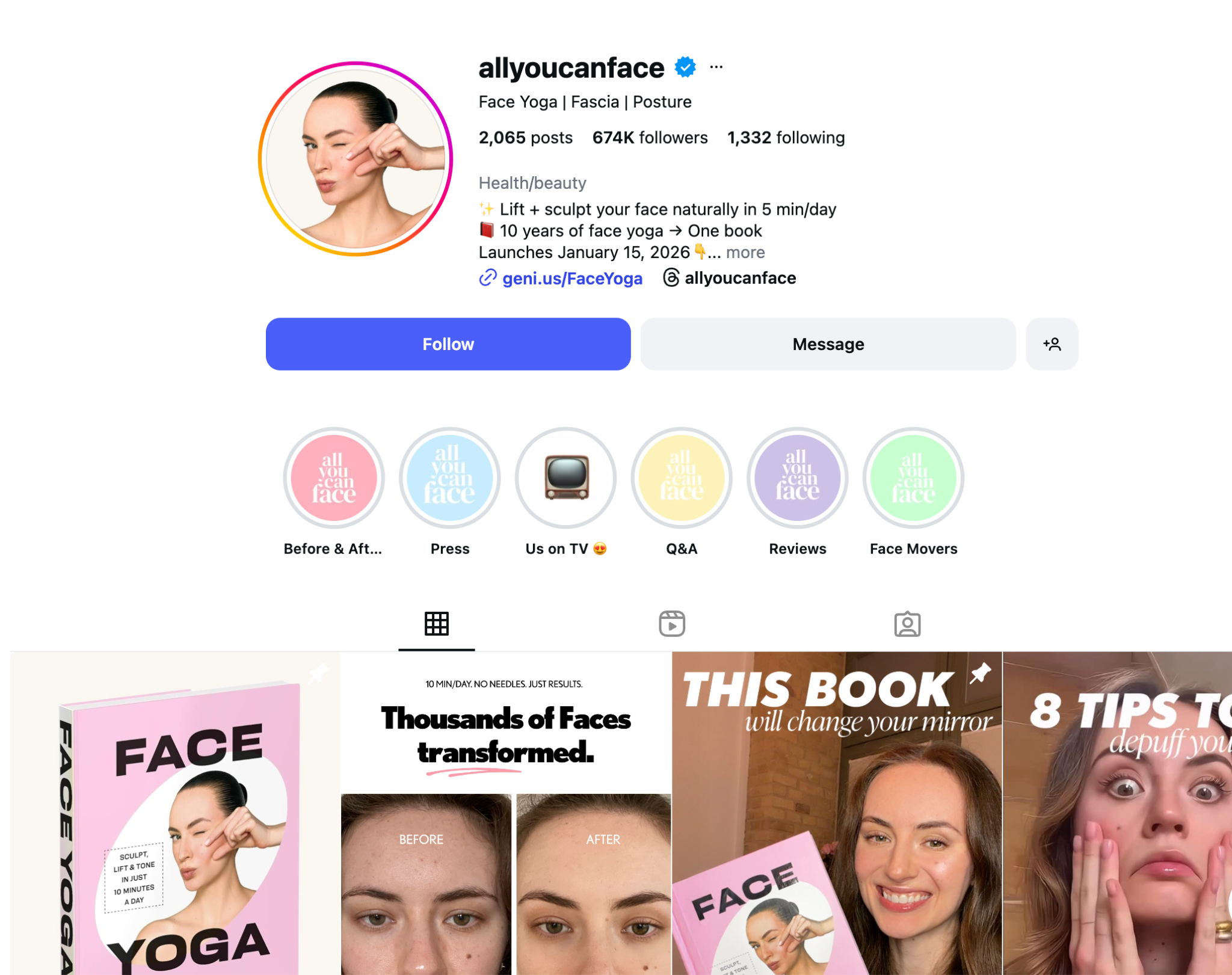
The SaaS Product (WordPress Tool): We narrowed another client’s focus from “all website owners” to Developers at boutique agencies. This specificity allowed us to speak their technical language fluently from day one.
Context & Influence: Using SparkToro for audience intelligence, we discovered their most active social networks were actually YouTube and Facebook groups.
Action items of step 1
Write down what you know about your target audience:
Define the Identity: Not just “HR,” but “High-stress HR Directors in Tech”.
Map the Context: Pinpoint exactly where they hang out.
Identify Influence: List the thought leaders they already trust.
Audit Competitors: Analyze what competitors are doing to draw them in.
Step 2: Making assumptions
Now that we have identified the audience, we can focus on the first pillar: getting their attention.
Assumption 1 - “Being in the know”
If you want to make it on LinkedIn or any high-signal platform, you have to be in the know.
In professional circles, attention is granted to those who act as information liaisons.
This role is built on two distinct layers: your Sources (where you find the signal) and your analysis (how you process it).
1. Your Information Sources
Industry Pulse: Following news, trends, and the playbooks of top-tier influencers.
Active Participation: Being part of a community or “Building in Public.”
Primary Research: Proprietary data, deep-dive research, and analysis.
Direct Feedback: Real-time conversations with your target audience.
2. Your analysis
Curation: High-signal commentary on existing news.
Logic Structures: Frameworks and mental models.
Proof Points: Case studies and “Evidence of Results.”
Strategic Narrative: Professional stories and forward-looking predictions.
Dissent: The “Contrarian POV” that challenges the status quo.
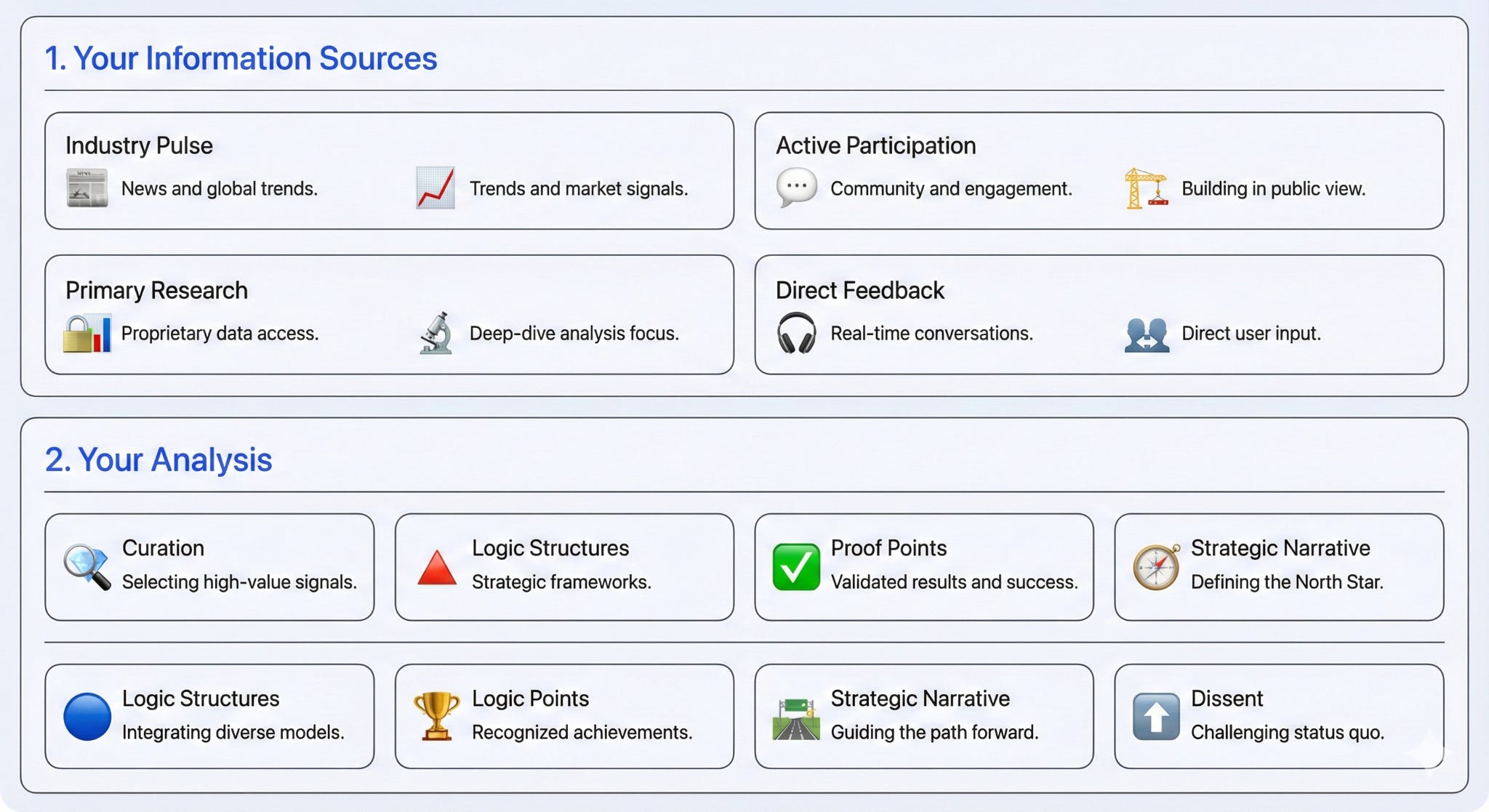
Note: While this list resembles a formats list, which I will discuss in future articles, there’s a distinction. Formats are the end result, while “being in the know” is the role you take on for the audience.
Figuring out which liaison role is the right fit for your business often requires analyzing your ecosystem. Look at how similar influencers or founder-competitors are leveraging these roles to see where you are best to position yourself.
Assumption 2 - How can I get their contact details?
The second question you must answer is how to contact your audience directly.
You may have 500K followers on LinkedIn, but that is fragile leverage if a single algorithm update suddenly minimizes your reach, a shift we’ve seen accelerate significantly over the last year on LinkedIn.
To future-proof your influence, you must move followers to owned channels (email, phone or WhatsApp) so you can communicate on your own terms.
There are many ways to capture contact details, but the key is to prioritize low-friction value. Ask yourself: What is the simplest, non-spammy, “win-win” exchange I can offer?
High-Signal “Win-Win” Examples:
The Utility Freebie: A plug-and-play template or checklist that provides an instant win.
The Curated Newsletter: A weekly email to keep your audience updated.
Exclusive Access: Early looks at a piece of content you are writing.
The Low-Stakes Audit: A simple tool or quiz that gives them a personalized result.
Assumption 3 - How can I get them to buy?
The final question you need to answer in the kickoff has to do with the last step of the funnel. Getting them to buy from you.
This isn’t just about generating revenue. Understanding the mechanics of how your audience buys and what they value enough to pay for reverse-engineers your top-of-funnel strategy.
The logic is simple: If your audience is willing to pay for a specific solution, they are almost certainly searching for content related to that problem for free. By identifying the paid solution first, you ensure your free content is perfectly aligned with your business goals.
Action items of Step 2
Write down your 3 core assumptions:
Authority & Sources: Define how you will establish yourself as an expert (”being in the know”) within the specific channels your audience trusts.
Owned audience Strategy: Determine the exact mechanism you will use to capture contact details and establish a direct connection.
Conversion Logic: Identify the specific value or solution your audience prioritizes enough to commit to a purchase.
Step 3: Execution
You now have a set of working assumptions on how to capture attention, secure contact details, and drive conversion. The next step is to initiate the cycles that will validate these hypotheses.
To maintain momentum, I recommend working in two-week sprints. During each cycle, you will address three core questions through specific audience-related activities:
How to get their attention: Is your content resonating? Are people commenting? If you get no response, send your content directly to people in your network who fit the target audience profile to get their feedback.
How to get their contact details: Test your chosen capture method to see if you can build a consistent “base group.” A good rule of thumb is a minimum of 10 new subscribers per week.
How to sell them: Start getting on sales calls. In the early days, content rarely produces calls immediately. Use direct outreach to fill the gap while your content engine builds momentum.
This isn’t a one-and-done setup; it is a continuous process of publishing, analyzing data, and sharpening your strategy until these three questions are fully answered.
Action items of step 3
Write down if a certain content bombs or succeeds exceptionally well. Seek direct feedback if engagement is low.
Write a summary of how the sales calls went. It’s important to capture this feedback right as it happens.
Step 4: Measurement & course correction
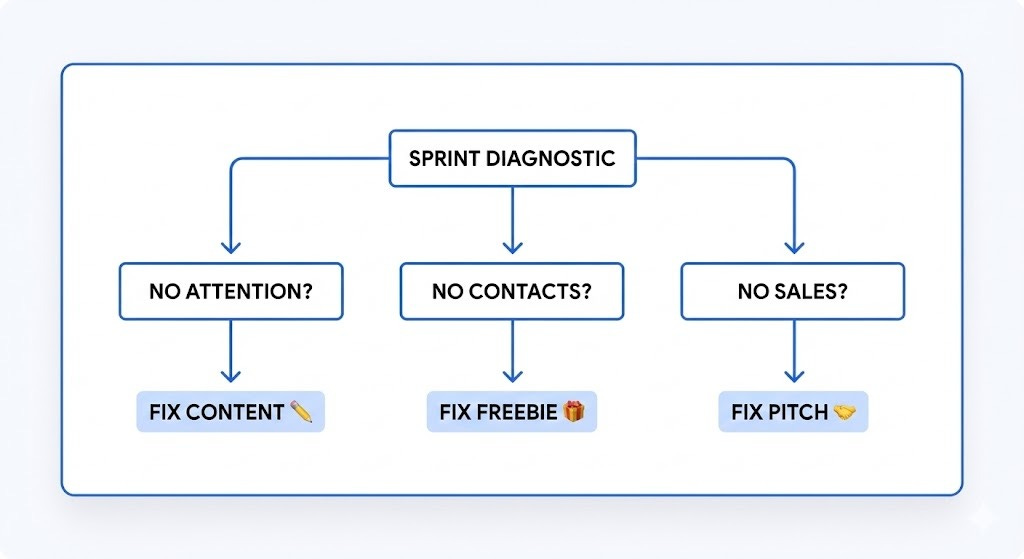
Now you need to make a decision: do you change your assumptions or continue? Review your sprint data and answer these four diagnostic questions:
The Attention Signal: Did the content generate engagement (comments/shares) from the actual target audience, or just from your existing peer group?
If no: Your “in the know” assumptions might be misaligned with the audience’s interests.
The Friction Check: Did people click your link or engage with your “win-win” offer?
If you hit the 10+ subscriber goal, keep going. If not, your “Minimum Viable Value” isn’t high enough to warrant an email exchange.
The Sales Reality: Did you manage to make a sale?
If you are recording the sales calls, upload the ones you closed to a tool like NotebookLM and ask AI whether the sales call corresponds with your assumptions.
The Pivot Decision: Based on the feedback, which part of the funnel is the current bottleneck: Attention, Connection, or Conversion?
The Path to Lasting Relevance
Finding the balance between ignoring your audience and obsessing over them is the ultimate challenge.
I’m reminded of those “HubSpot-style” persona documents. Static files that often lead to more confusion than clarity.
In reality, being relevant is far more important than having a perfectly defined profile. Your audience is not a static data point. They are fluid, changing human beings, just like you.
By “staying in the know” and maintaining a continuous conversation through your content, you move away from guesswork and into alignment.
True success doesn’t come from knowing exactly who they were when you started, but from iterating your knowledge alongside them as they evolve.