

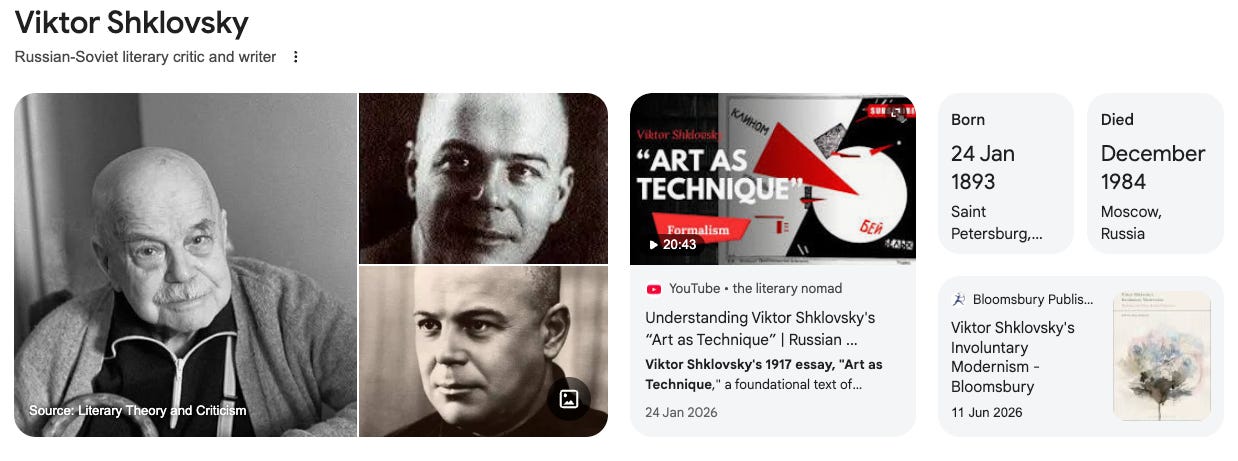
In 1917, a Russian critic named Viktor Shklovsky wrote about Tolstoy’s story Strider, told from the perspective of a horse.
Through the horse’s eyes, ordinary things like ownership and money suddenly look absurd.
That, Shklovsky said, is what art is for. Habit makes us stop seeing the world, and art makes the stone stony again.
Why am I writing about a literary critic from over 100 years ago?
Because AI is a pattern machine, and Shklovsky’s idea of Estrangement is how your content gets seen beyond the pile of AI slop posts being published.
The Theory of Estrangement
According to Shklovsky’s essay “Art as Device,” the more often we encounter something, the less we perceive it.
Shklovsky called this automatization.
When you first learn to drive, you notice every mirror and pedal. A year later, you arrive home with no memory of the trip.
Habit is efficient, but it has a cost. Shklovsky wrote that it swallows everything: our clothes, our furniture, our spouses, even the fear of war.
We stop living those things and just register that they’re there.
He borrowed an example from Tolstoy’s diary. Tolstoy was cleaning his room and couldn’t remember whether he’d already dusted the sofa. He’d done it so automatically that it left no trace. If that’s how we live, Tolstoy wrote, it’s as if we never lived at all.
Art, for Shklovsky, is the counterforce. Its job is to slow perception down and make us feel the thing again. The technique he named for this is ostranenie, estrangement: presenting something familiar as if it were being seen for the first time.
How this is still a driving force in film
Using Estrangement to get attention is quite common in movies and shows.
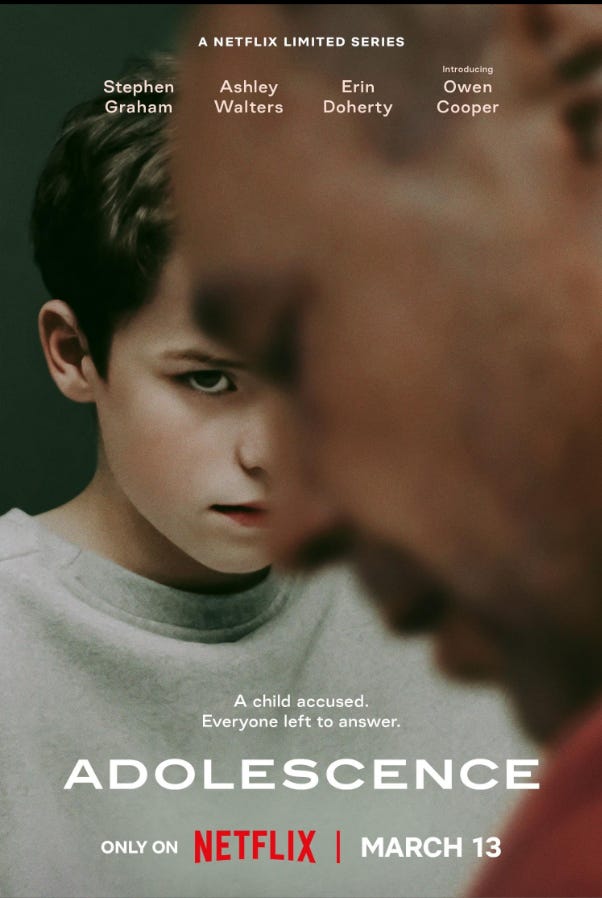
Like the series Adolescence, filmed entirely in one continuous take per episode.
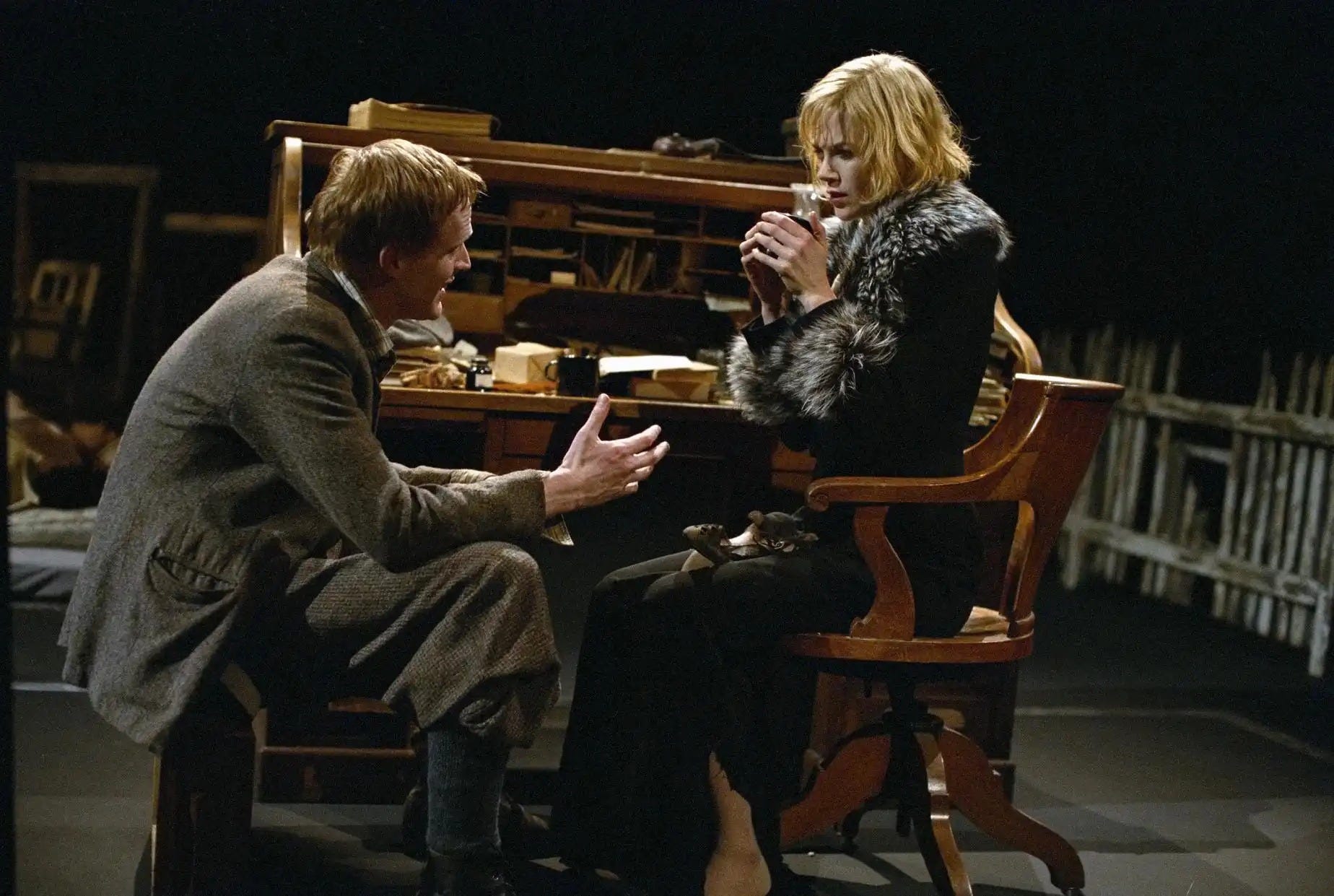
Or Dogville from 2003, where Lars von Trier almost completely stripped away physical sets, keeping just a chalk outline on floors and a few props.
Look at this year’s hit film Backrooms, which takes the internet phenomenon of ‘liminal spaces’ and turns it into a feature film.
Liminal spaces are transitional places, like hallways, empty offices, waiting rooms, and malls after closing.
The film skips the usual horror conventions and adapts the internet horror myth of the Backrooms, built on the liminal-spaces aesthetic. The result feels like a new kind of horror movie. That’s Shklovsky’s Estrangement at work.

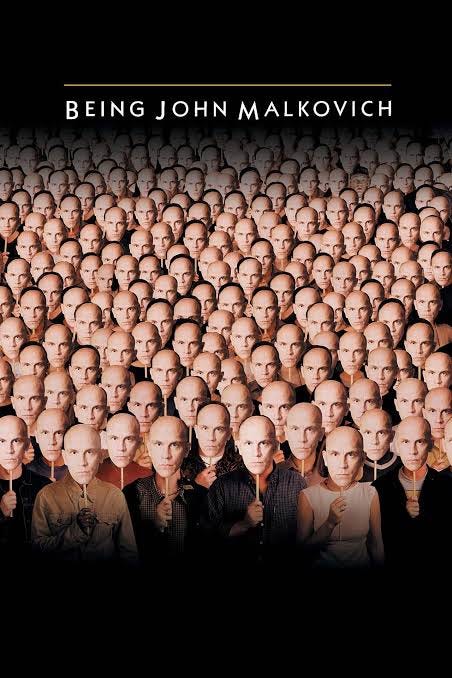
And I can’t end this list without mentioning Being John Malkovich, which I recently saw for the millionth time, this time with my son who’s 12 years old.
OK, let’s tie this back to marketing.
I recently saw a LinkedIn post by Dave Gerhardt promoting his next event.
He applied this exact technique to give a different spin to his event.
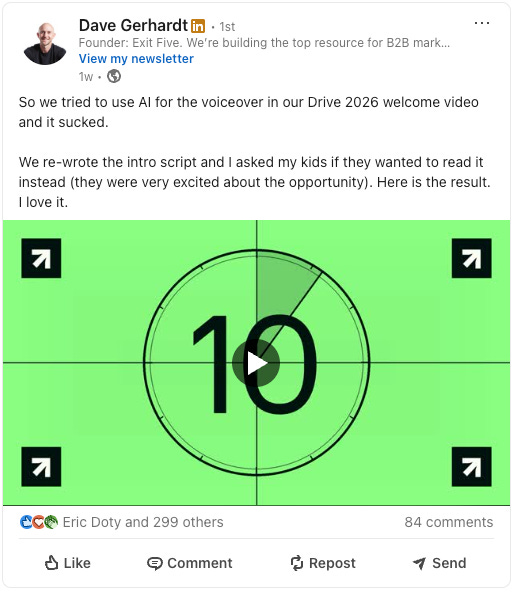
At the start of the video, his kids read the welcome message for the event.
Framing it as “We tried AI, but it sucked, so we used my kids instead” offers a refreshing alternative to standard event promotion. I’m not sure the post would have worked without the “VS AI” framing.
How to do it yourself
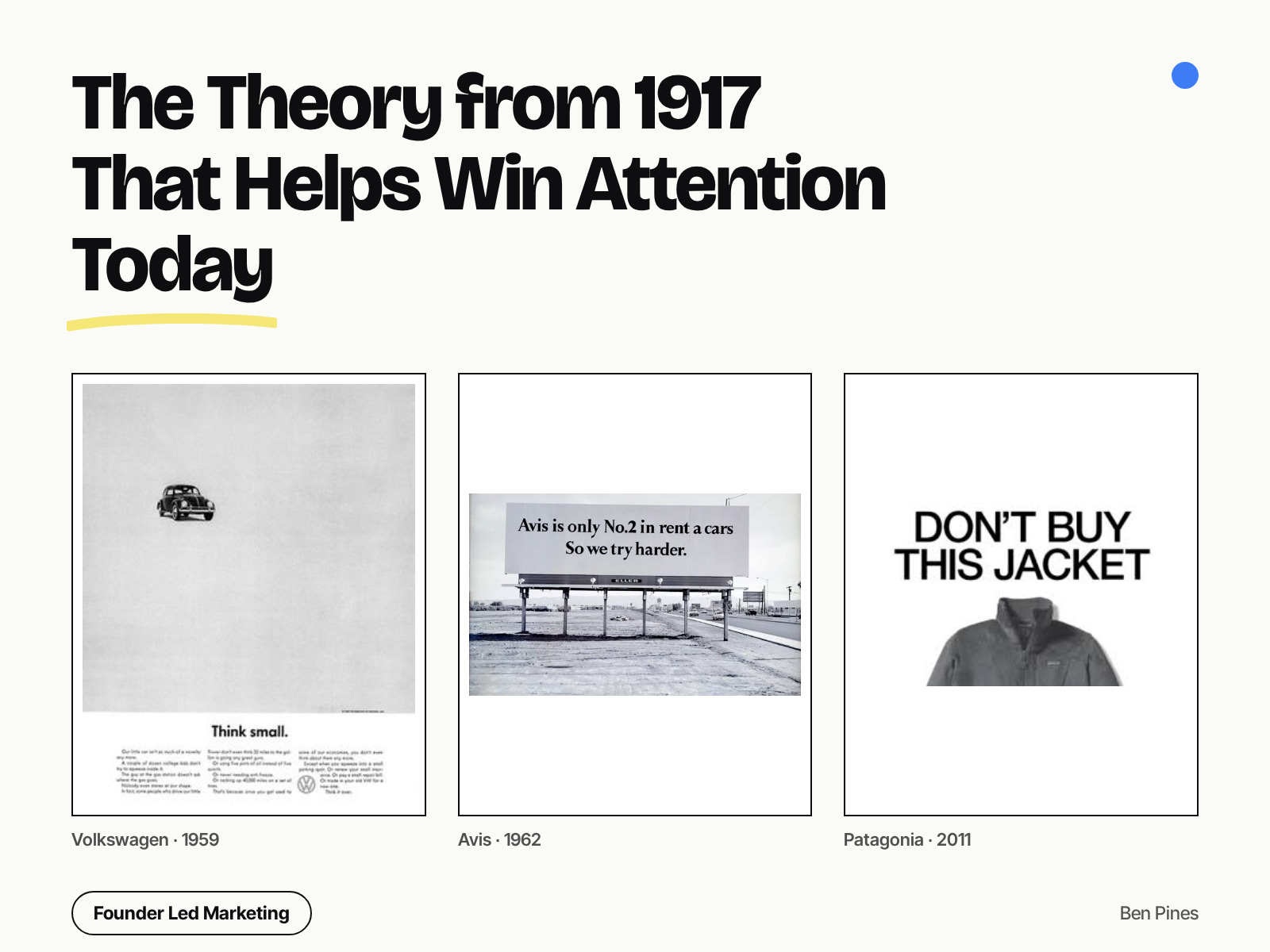
Everyone remembers the VW “Think Small” ad.
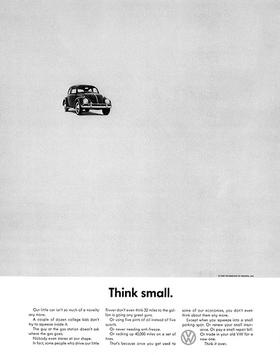
It’s still being talked about today.
There’s no real process for Estrangement, but there are parts we can mention by analyzing this ad:
Know the convention.
Every American in 1959 knew what a car ad looked like. Big, shiny, aspirational.Estrangement.
Find an angle that makes the familiar thing look strange.
Julian Koenig, the creator of the ad, probably had this thought in mind:What if we made almost the entire ad empty, with a copy that says the opposite of what people expect, something that can even be seen as negative.
AKA Think small.Conventions kept.
I think this part gets ignored. To make Estrangement work, you have to keep enough of the form that it still reads as the thing you are trying to create.
That’s the place where I usually have to put the most effort. If I find a way to write a LinkedIn post in a new way, I have to make sure people still register it as a LinkedIn post, and not as something illegible.
“Think Small” still has a headline, body copy and a logo. Break everything and the Estrangement process won’t work.
Here is the same process of Estrangement, illustrated with the example of the film Dogville.
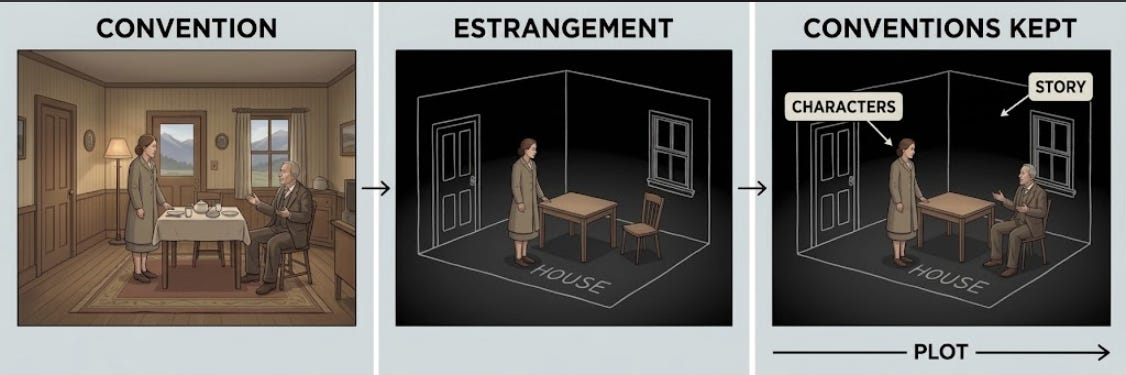
You start with the conventional scene happening in a house. You Create something new by removing the entire set. You maintain the basic elements needed to still consider Dogville a film.
To me, framing my job as a marketer as ‘someone who professionaly breaks norms and conventions’ gives me an operational lens for looking at marketing.
It also motivates me to create something new, even when AI can produce content too.
If AI keeps improving, I’ll keep improving too, and keep finding the parts of me that can’t be replicated. Evolve with AI, if you will.
Now to you - I say give it a go. Take one of your upcoming LinkedIn posts, and try to think: how can I frame this in a way that would make it strange and unfamiliar to the reader?