

When someone does well on LinkedIn, the easy thing is to copy what you can see. The tone, the length of the posts, the way they open. I think that’s mostly a waste of time.
In this series, I analyze the decisions behind the posts.
I did it for Anthony Pierri, and now comes Mike Rosenberg.
To really get what Rosenberg does well on LinkedIn, I set out to examine two months of his posts.
I pulled 42 of them and tagged each one by topic and format. Here’s some of the important things I’ve learned.
Who Mike Rosenberg is
Mike Rosenberg has been writing professionally for 19 years. He was a journalist for 12 of them, and for the last 7 he’s been ghostwriting LinkedIn posts for founders and CEOs.
But he only started posting on his own account a year ago. Since then he’s reached 13k followers and 5.5 million impressions.
More importantly, it’s working as a business. He booked 34 coaching clients in four months, got enough ghostwriting interest to double his prices, and got a write-up in Inc.
And he did all of it without using AI. Not for writing, not for editing, not for ideas. That’s not a side detail. As you’ll see, it’s a huge part of his whole strategy.
Here are the points to learn from Rosenberg:
1. Mike is running a POV strategy, centering around one position: The Anti-AI writing stance.
About two-thirds of Mike’s posts are about AI. Roughly 19 of the 42 are specifically about AI writing.
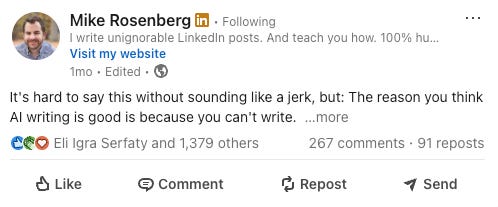
His position is simple: AI writing is bad, and you should use your own brain.
He argues it in almost every way possible:
You think AI writing is good because you can’t write.
“AI is democratizing writing” is nonsense.
Using AI to write is like driving a car to finish a marathon.
Why this strategy is good for his business
What makes this work as a business is that the position and the offer are the same thing.
Mike sells ghostwriting and coaching from someone who doesn’t touch AI. He even describes his coaching as a kind of “brain rehab” for people who went down the AI rabbit hole. So every post against AI is also a reason to hire him.
Generally speaking, I would characterize this method as a POV strategy. You have a contrarian view around one main topic, and base your content on that.
He’s not the only one doing the POV strategy.
Chris Walker built a following by arguing against attribution software, and that’s exactly the problem his demand generation agency solved.
Rand Fishkin has spent years arguing that Google keeps traffic for itself, which points straight at SparkToro, his audience research tool.
For founders: If you’re a founder, this is the first thing to figure out: what position does your product prove? Can you build your own position on LinkedIn around this?
Say you built a tool for continuous employee feedback. Your position could be “annual performance reviews don’t work.” Every time you argue that, you’re making the case for your product.
2. Mike uses plain text, no visuals
Almost everything Mike posts is just text. No carousels, no diagrams, no photos.
This is a big deal if you’re a founder who’s short on time. A good visual can take an hour to make, or a designer. Mike shows you don’t need either. If the idea is strong, the text carries it.
That doesn’t mean visuals don’t work. Last week’s founder, Anthony Pierri, built his whole LinkedIn presence on diagrams. It’s more a matter of your choice.
3. Not just a simple POV strategy, Mike found the right contrarian view.
While Mike focuses on opinion posts, HOW he does it is the interesting part, since most POV strategies I’ve seen fail.
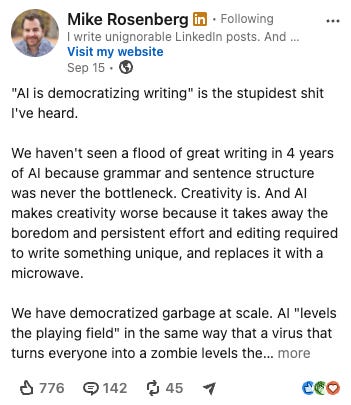
A lot of Mike’s posts start with something everyone says, and then he argues against it.
“AI is democratizing writing.” He says grammar was never the problem, creativity was, and AI makes creativity worse
“Use AI to write your emails.” He says this treats writing as a chore we’ve outgrown, when writing is how we think
“Why do you still write when GPT can do it for you?” He answers with a list: why eat when there are nutrient shakes, why walk when you can drive
He does the same with LinkedIn advice:
Don’t use hooks, just say what you want to say.
Don’t plan content pillars, experiment and listen to your audience.
Most LinkedIn advice argues differently.
He even has a rule for it: if nobody would disagree with your post, it’s not a post. His example is a logistics founder writing “customer experience matters.” Is anyone going to argue with that? No. So nobody remembers it either.
For founders: this is the format you can actually keep up with. You already have opinions about your market. You say them in sales calls, in team meetings, to investors. Writing one down takes 15 minutes, and you don’t need to prepare anything.
BUT - you have to know how to do it right, and more specifically develop a strong contrarian view for each post.
Part 2 of My analysis: Mike’s posts
1. Mike’s LI post about why people hate AI shows his unique method of theorizing (like a journalist)
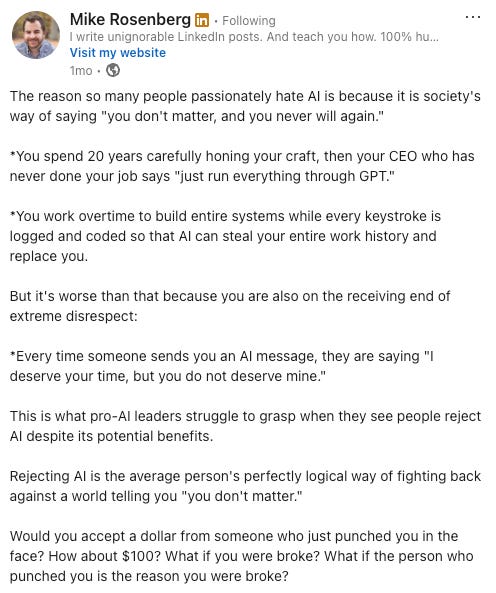
From the post: “The reason so many people passionately hate AI is because it is society’s way of saying ‘you don’t matter, and you never will again.’”
This post is a great example of how Rosenberg has a question - and then formalizes a theory to answer it.
It’s how Mike approaches a problem. Like a journalist, he looks for the cause underneath it.
He uses the same method in other posts:
AI hate is so strong because it reflects Americans feeling powerless. He lists example after example, from data centers approved in secret to rising electricity bills
Schools, companies, and LinkedIn all contradict themselves on AI, and each time the root cause is money
None of these posts offer a fix. They explain the problem, diving into the problem like a journalist, but keeping it in the format of the short LinkedIn post.
For founders: You don’t have to solve the problem in every post, and you don’t have to just mention it either. You can theorize about it. Why does this problem keep happening? Who benefits from it staying this way? If you explain your buyer’s problem better than they can, they’ll assume you’re the one who can fix it.
2. Mike’s post about LinkedIn’s AI slop button shows how he uncovers the story behind the news (like a journalist)
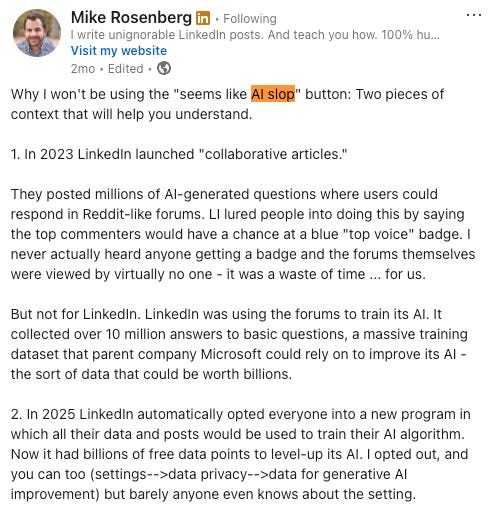
When LinkedIn launched a button to flag posts that “seem like AI slop,” most people reacted to the button. Mike went back and found the story behind it.
He laid it out in three steps:
In 2023, LinkedIn launched “collaborative articles,” AI-generated questions that users answered for a chance at a “top voice” badge. Mike says almost nobody read them, but LinkedIn collected over 10 million answers, the kind of data you can train AI on.
In 2025, LinkedIn automatically opted everyone into having their posts used to train its AI.
Now there’s a button where you flag AI slop.
His conclusion: every time you flag a post, you’re teaching Microsoft’s AI to tell good content from bad, for free. So he won’t use the button.
This post required real knowledge and real research, even though it was an opinion post.
For founders: when something happens in your industry (a new regulation, a competitor’s launch, an acquisition), piece together the backstory. What led to this? What does it actually mean? Nobody else will do that homework, and it shows buyers you know the space from the inside.
3. Mike’s post on eight AI studies shows how he lets the research do the arguing (like a journalist)
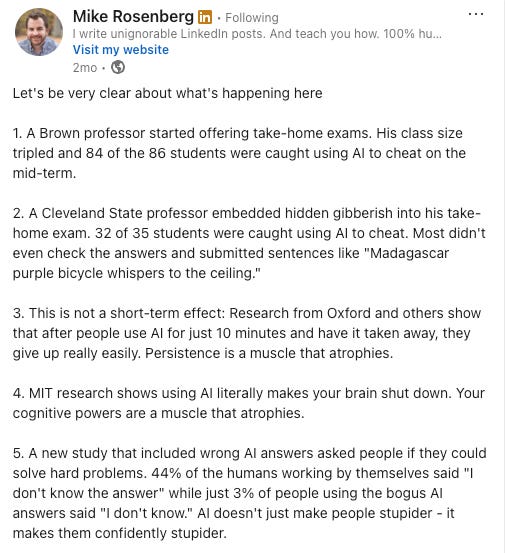
Mike’s biggest post in these two months has almost no opinion in it.
It opens with “Let’s be very clear about what’s happening here,” and then it’s just research, one study after another:
A Brown professor caught 84 of 86 students using AI to cheat on a take-home exam
Research from Oxford and others found people give up more easily after just 10 minutes of using AI…
There are eight points like that. He only adds a few lines of his own at the end.
It got 2,524 reactions and 331 reposts. That’s about twice his next best post, and roughly four times the reposts. People share proof more than they share opinions, because sharing proof makes them look smart too.
For founders: collect the data that backs your position. Studies, industry reports, your own customer numbers. Put it all in one post and keep your opinion short. If your numbers are strong, they’ll make the argument better than you can.
4. Mike’s post about Claude’s watermarks shows how he uses the news
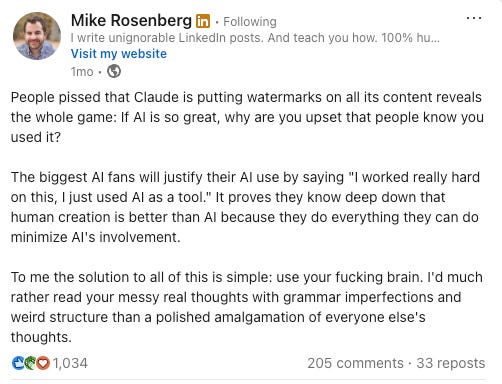
When Claude started putting watermarks on AI content, a lot of people were annoyed. Mike posted about it right away. What’s interesting is that he doesn’t just give his opinion, he ties it into his whole position.
His take: “If AI is so great, why are you upset that people know you used it?”
People who love AI, he says, defend themselves by saying they worked hard and only used AI as a tool. That proves they know human work is better, because they try to make AI’s part look as small as possible.
The post adds a take nobody else has.
For founders: when something happens in your market, don’t just share the headline. Say what it means, and if possible connect it to the position you always argue.
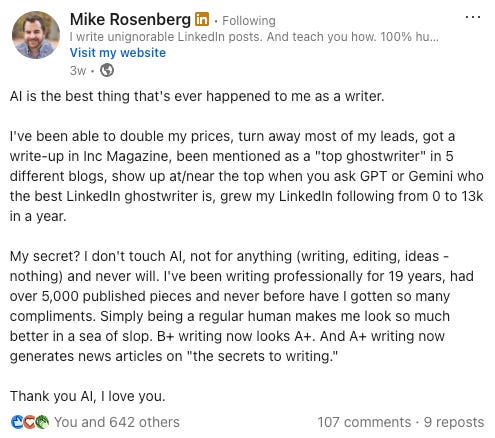
5. Mike’s “AI is the best thing that’s ever happened to me” post shows how he turns his position into proof
When I coach clients, I often tell them about the importance of “promotional posts”.
These posts are meant to show your audience proof your business works and is successful.
That’s what Mike does in such posts, but in a way that is not salesy.
He ties it into his position:
I’ve been able to build a successful business BECAUSE of AI, meaning because I differentiated myself to everyone else using AI.
Follows with points that prove he indeed runs a successful business.
He shares how he doubled his prices, turned away most of his leads, got a write-up in Inc, was named a “top ghostwriter” on 5 blogs, and grew from 0 to 13k followers in a year.
These posts show that refusing AI actually pays. That’s the step from “I agree with this guy” to “I should hire this guy.”
He doesn’t post them often, just a handful in two months. That’s probably smart. Too many and it becomes bragging.
For founders: every so often, show what your position has gotten you or your customers. Numbers, results, recognition. Tie it back to the position you always argue, so readers see that it’s not just an opinion. It works.
Final takeaway
Mike Rosenberg has one position: AI writing is bad, and you should use your own brain. It’s also exactly what he sells.
Like we’ve seen, he shows the same position in several ways. We covered some of them: promotional posts, newsjacking posts, POV posts. There are others (like his satirical short posts).
The main takeaway is being able to repeat the same position in a variety of formats. I see few people on LinkedIn doing that.
He writes it mostly as plain text opinions, often arguing against what everyone else says. Then he keeps it fresh by changing the format. He theorizes about why people hate AI, digs up the story behind LinkedIn’s slop button, lines up eight studies, jokes, runs experiments, and shows the results his position has gotten him.
That’s how he posts almost every day without running out of things to say, and without sounding like he’s repeating himself.
If you’re a founder, you don’t need visuals, hacks, or a long list of content ideas. You need one clear position tied to your business, and as many ways to say it as you can find. Copy the structure, not the tone.
Who should I analyze next? Reply and let me know.